A young Crow scout, enlisted with the cavalry only weeks earlier, watched from a distant ridge as the soldiers he had ridden with disappeared under a rising cloud of dust and gunsmoke. He had been sent away before the fighting reached its worst, and he stayed just long enough to see that no one down there was coming back. A day or two later, he reached a steamboat on the Yellowstone River and became the first person to tell the outside world what he had seen.
Little Bighorn: The Road to Battle
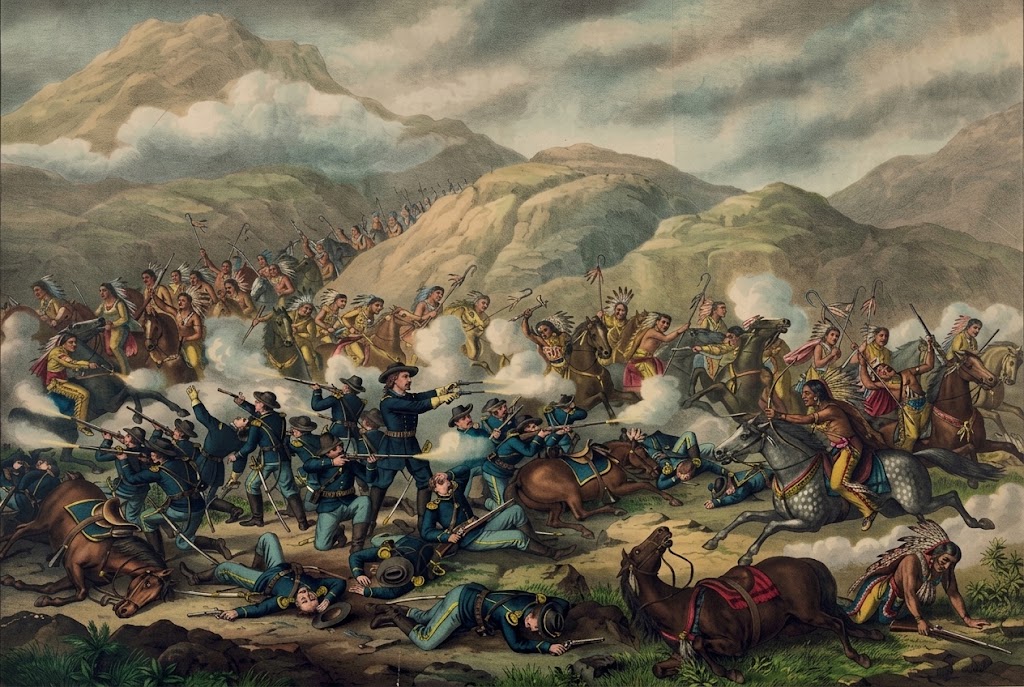
By June 1876, the United States Army was pursuing a campaign to force the Lakota, Cheyenne, and Arapaho off lands guaranteed to them by treaty but newly coveted after gold was discovered in the Black Hills, driving thousands of Native families to gather in a large combined village along the Little Bighorn River in Montana Territory rather than report to reservation agencies. Three separate army columns, under Generals Alfred Terry, George Crook, and John Gibbon, converged on the region that spring intending to trap the combined village between them, a plan already thrown off balance after Crook’s column was fought to a standstill and turned back by Lakota and Cheyenne warriors at the Battle of the Rosebud barely a week before Custer reached the Little Bighorn.
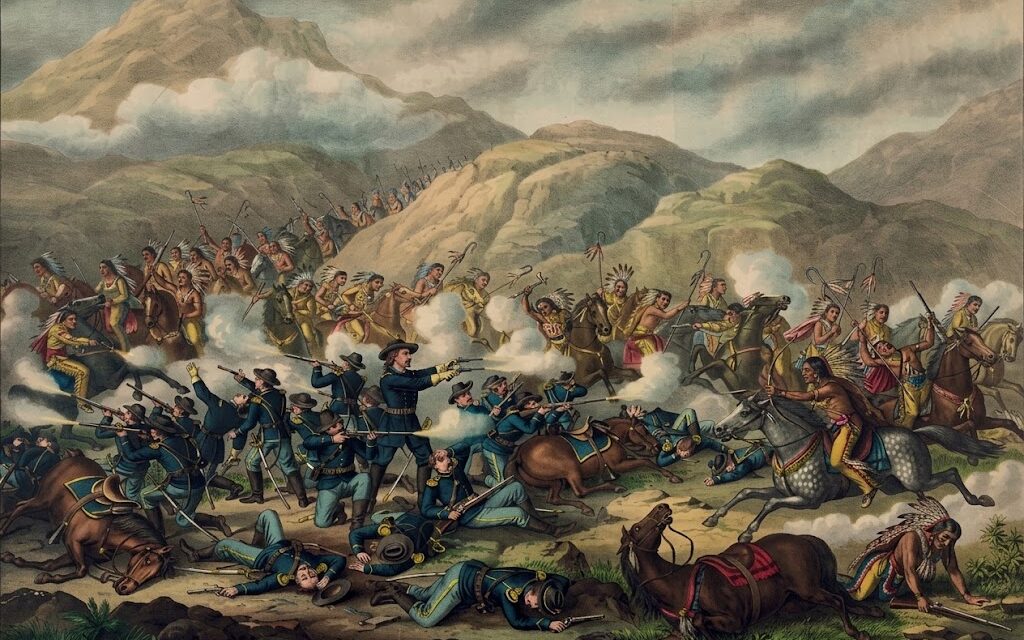
Lieutenant Colonel George Armstrong Custer, leading the 7th Cavalry as part of Terry’s converging force, came upon the village’s trail and, believing his approach had already been discovered, chose to attack immediately rather than wait a day for Terry and Gibbon’s infantry to close the remaining distance. He split his roughly 600-man regiment into three battalions, sending Major Marcus Reno’s men to charge the village from the south while Captain Frederick Benteen’s battalion scouted to the southwest, and kept around 210 men under his own direct command for a wide flanking movement to strike the camp from the north.
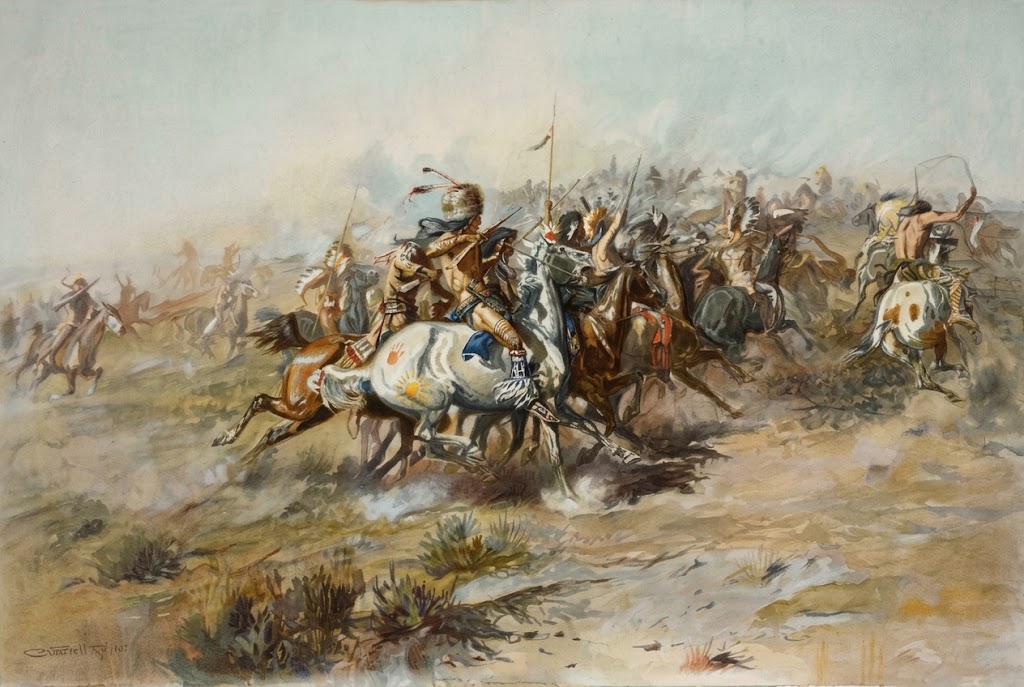
It was one of the largest concentrations of Native warriors ever assembled on the northern Plains, likely numbering well over a thousand fighting men, far more than Custer’s scouts had reported or that he appears to have anticipated. The village itself stretched for roughly three miles along the river, made up of Lakota, Cheyenne, and a smaller number of Arapaho families who had gathered together that summer in numbers no single army detachment had previously encountered on the Plains.
The Battle of Little Bighorn
Reno’s charge collapsed almost immediately once his roughly 175 men encountered the true scale of the village, forcing a chaotic retreat across the river and up onto the bluffs, where his survivors, soon joined by Benteen’s battalion, dug in and held out under siege for two more days until the army’s relief column arrived. Major Reno later testified at the 1879 Reno Court of Inquiry, which he himself requested to answer accusations of cowardice, that his initial charge had been halted by overwhelming warrior numbers and that the retreat, however disorganized, had been forced rather than chosen; the inquiry ultimately found no grounds to condemn his conduct, though the controversy has followed his name ever since.
While Reno’s men fought for their own survival on the bluffs, Custer’s separate column of roughly 210 men was surrounded and destroyed within the same afternoon, several miles away and beyond any hope of relief from the rest of the regiment. No soldier in Custer’s immediate command survived to describe what happened there, so nearly everything known about his final fight comes from the accounts of the warriors who fought against it and the physical evidence later gathered from the battlefield itself. Rain-in-the-Face, a Hunkpapa Lakota warrior who fought in the battle, later gave blunt, unromanticized interviews pushing back against heroic popular depictions of Custer’s final fight, describing soldiers dismounting to fight on foot with every fourth man holding horses, and recalling the chaos of the engagement as something closer to running in the dark than a clean, dramatic last stand; he also claimed to have taken part in the fighting that killed Custer’s brother Tom, one of several Custer family members who died on the field that day.
Red Horse, a Minneconjou Lakota chief whose lodge stood at the center of the village, later testified before army officers in 1881 and produced 42 detailed drawings documenting the fighting, describing the initial cavalry charge, the retreat of soldiers back across the river, and warriors gathering weapons and ammunition from the dead soldiers as the fighting moved toward the hilltop. He argued that Custer’s decision to split his command had sealed the outcome, since keeping the regiment together would have cost the Lakota and their allies far more heavily than the roughly 210 soldiers who died with Custer, and he estimated his own people’s losses at 136 killed and 160 wounded, a toll that, while smaller than the army’s, was still severe for the village.
The Legacy of Little Bighorn
Little Bighorn stands as one of the most complete Native American military victories of the Indian Wars, and also one of the last, since public outrage over Custer’s defeat hardened federal policy and accelerated the very campaigns to confine Lakota, Cheyenne, and Arapaho bands to reservations that the battle had briefly interrupted. The battlefield today works to hold both halves of that history at once, a tactical Native triumph that became, within a year, a strategic loss for the same peoples who won it, and a site where honoring the fallen on both sides remains an active, ongoing negotiation rather than a settled matter of the past.
Visiting Little Bighorn Battlefield Today
Little Bighorn Battlefield National Monument, managed by the National Park Service on the Crow Indian Reservation near Crow Agency, Montana, is open daily with standard daytime hours that run longer in summer and shorter in winter. A modest per-vehicle entrance fee applies, with free admission for children and standard National Park Service pass discounts, and the park does not accept cash, so a card is needed on site. Marble markers scattered across the hillsides show where individual soldiers fell, a nine-mile driving tour leads to the separate Reno-Benteen defense site where the siege survivors held out, and a visitor center and national cemetery round out the grounds.
Renting an audio guide or booking a tour with the Crow Tribe’s own Apsaalooke Tours is widely recommended for a fuller, Indigenous-perspective account of the battle that goes beyond the Park Service’s standard ranger talks, since the fight is remembered very differently depending on whose ancestors were on which side of the river that day. Visitors consistently recommend budgeting several hours to take in the visitor center, the driving tour, and the scattered hillside markers rather than treating it as a quick stop.
Remembrance at Little Bighorn
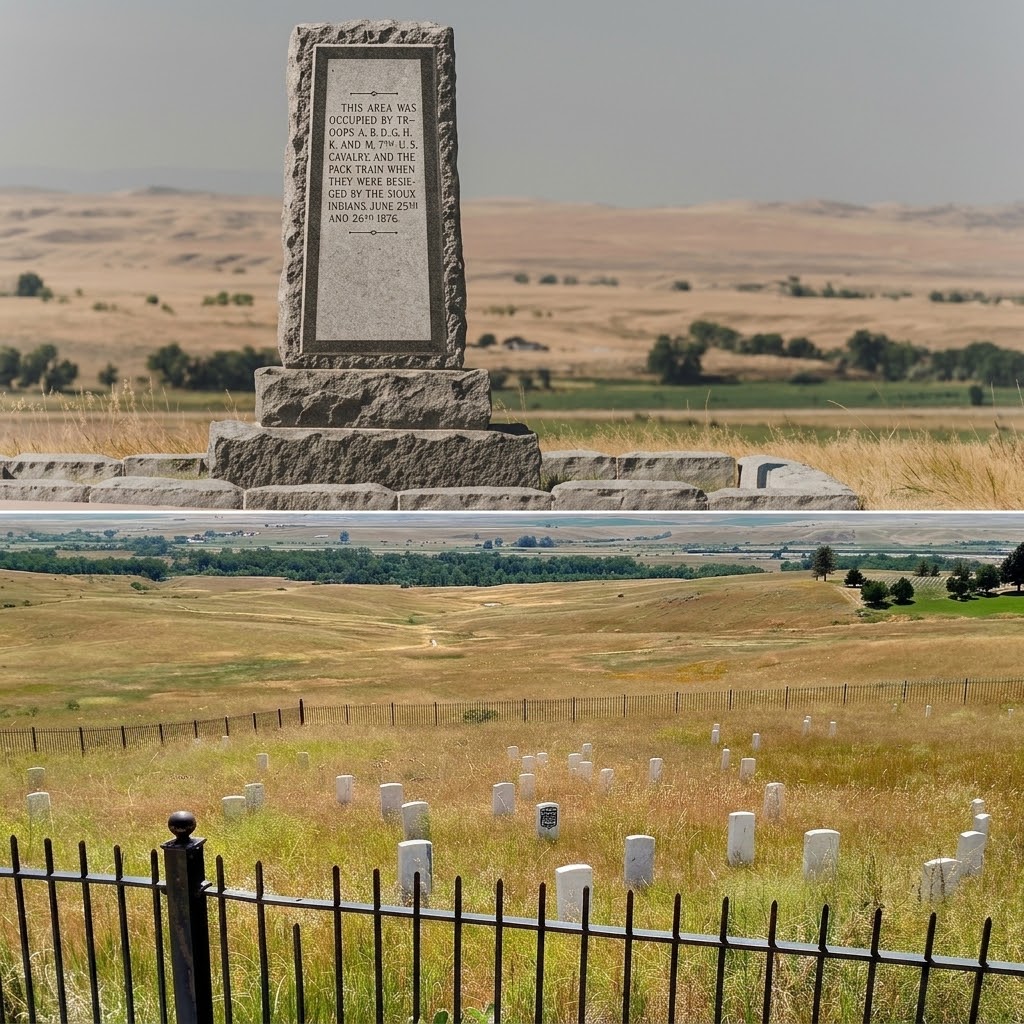
The park holds an annual commemoration around the battle’s June 25 anniversary, drawing descendants of both the 7th Cavalry and the Lakota, Cheyenne, and Arapaho nations whose warriors fought there. The battlefield’s marble markers, placed where individual men were found dead, give the hillsides an unusually literal form of remembrance, letting visitors trace the shape of Custer’s final stand and Reno’s retreat directly on the ground rather than through a single monument or plaque.
Visitor Info: www.nps.gov
Location: Little Bighorn Battlefield National Monument, 756 Battlefield Tour Road, Crow Agency, Montana 59022
Site Status: National Park / Managed Historic Site
Visitation Notes: Little Bighorn Battlefield National Monument, managed by the National Park Service near Crow Agency, Montana, on the Crow Indian Reservation, is open daily with standard daytime hours that extend later in summer and run shorter in winter. A modest per-vehicle entrance fee applies, with free admission for children and standard NPS pass discounts, and the park does not accept cash, so bring a card. The site includes a visitor center, a national cemetery, marble markers scattered across the hillsides showing where soldiers fell, and a 9-mile driving tour to the Reno-Benteen defense site; renting an audio guide or booking a tour with the Crow Tribe’s own Apsaalooke Tours is widely recommended for a fuller, Indigenous-perspective account of the battle beyond the Park Service’s own ranger talks. The park holds an annual commemoration around the battle’s June 25 anniversary.
Google Map
Visitor Comments
The Apsaalooke (Crow Tribe) van tour was absolutely wonderful and gave us a completely different perspective than the standard park signage. Don’t miss the van tour if you’re visiting this battlefield says Hafcanadian from Clackamas, Oregon.
— from TripAdvisor
Karen B says this is a great place to learn some history. Plan to spend several hours here between the visitor center, the driving tour, and the markers scattered across the hillsides.
— from Wanderlog
I knew nothing before I walked in, but I sure left a whole lot more informed remarks Kris B. The rangers and the exhibits do a good job laying out both sides of what happened here.
— from Wanderlog
The Crow (Apsaalooke) Indian Reservation is home to Little Bighorn Battlefield National Monument, one of the USA’s best-known Native American historic sites, marking the site of the 1876 clash between the 7th Cavalry and a combined force of Lakota, Cheyenne, and Arapaho warriors.
— from Lonely Planet