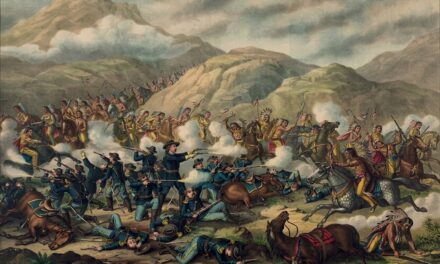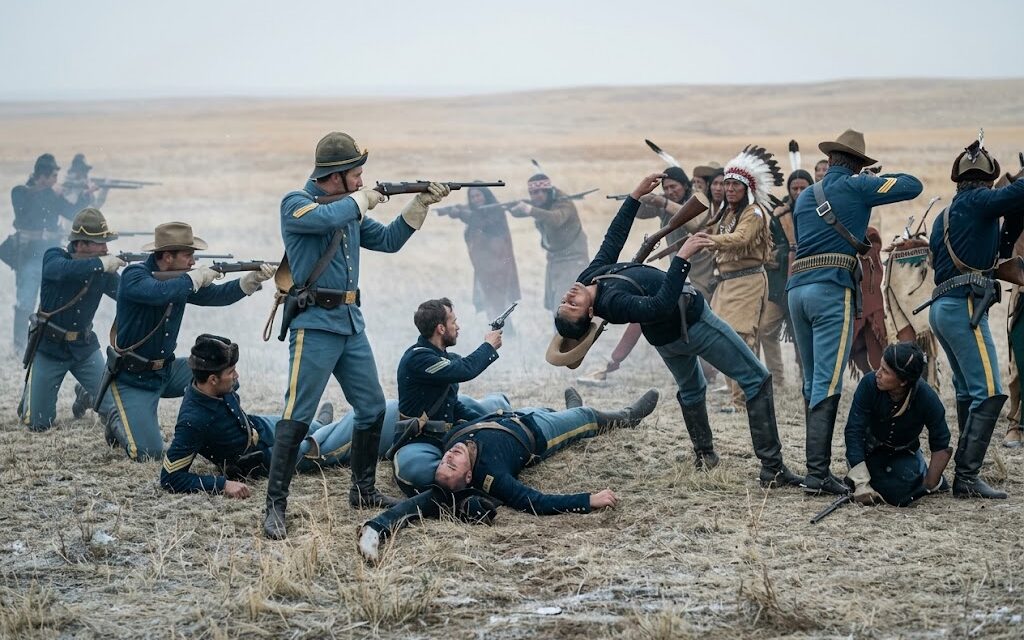
A single rifle discharged during a search for weapons, and within minutes, soldiers armed with rapid-fire Hotchkiss guns had turned the disarmament of a Lakota band into the deadliest mass killing of Native Americans by the U.S. Army in the nineteenth century. What began as a routine, if tense, military operation to collect firearms from roughly 350 Lakota men, women, and children camped along Wounded Knee Creek ended with the majority of them dead in the snow within a matter of minutes, many cut down as they fled across the surrounding ravines, in an event now remembered by historians and by the Lakota people themselves not as a battle but as a massacre.
Wounded Knee: The Road to Battle
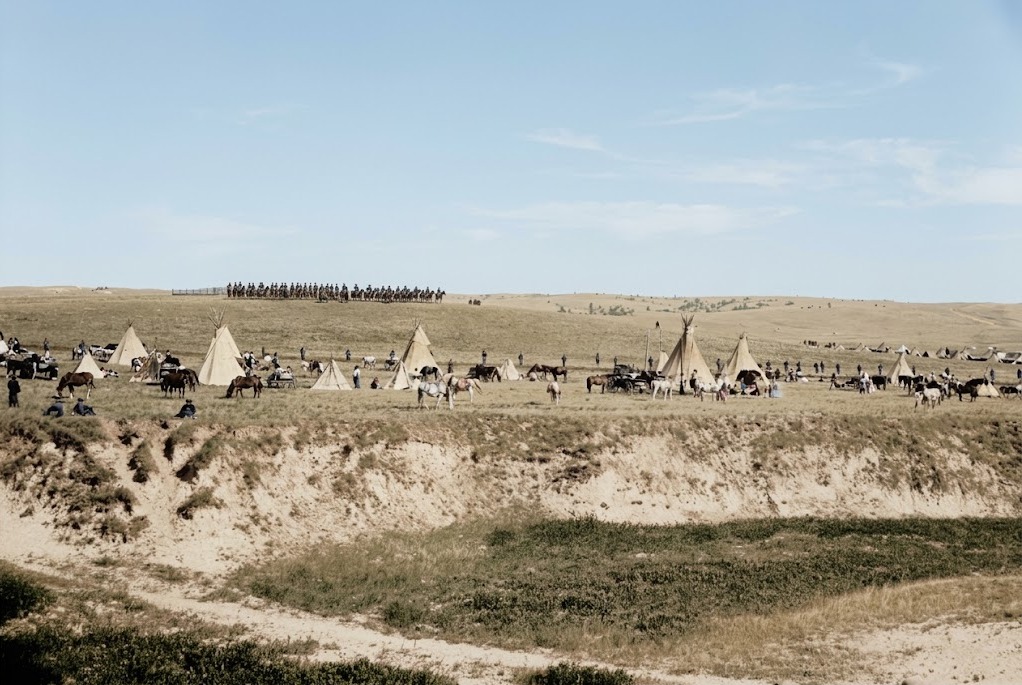
By the winter of 1890, the Lakota people on the Pine Ridge and other reservations were embracing the Ghost Dance, a spiritual movement promising the return of ancestral lands and the disappearance of white settlers, which alarmed federal Indian agents and military commanders who feared it signaled an uprising. Tensions escalated sharply after the killing of Sitting Bull during a botched arrest attempt at Standing Rock earlier that December, prompting a band of roughly 350 Miniconjou and Hunkpapa Lakota under Chief Spotted Elk, commonly known by the name Big Foot, to flee toward the perceived safety of Pine Ridge Reservation. The U.S. Army’s 7th Cavalry, the same regiment that had suffered defeat at the Battle of the Little Bighorn fourteen years earlier under George Armstrong Custer, intercepted Spotted Elk’s band on December 28, 1890, and escorted them to a camp along Wounded Knee Creek in South Dakota.
Spotted Elk himself was gravely ill with pneumonia during the march, riding in a wagon rather than on horseback for much of the journey, and had raised a white flag of truce when first approached by the cavalry, and the band offered no resistance as soldiers moved to set up camp around them for the night. Federal officials had grown increasingly anxious throughout the fall of 1890 that the spreading Ghost Dance movement, combined with the presence of armed and mobile Lakota bands off their assigned reservations, represented the opening stages of a broader uprising, an assessment many historians now regard as a serious overreaction to what was fundamentally a religious and cultural movement. By the morning of December 29, the Army had positioned roughly 500 soldiers and four rapid-fire Hotchkiss mountain guns on high ground surrounding the Lakota camp, vastly outnumbering and outgunning the band of men, women, and children below, and began the process of disarming the camp at daybreak.
The Wounded Knee Massacre
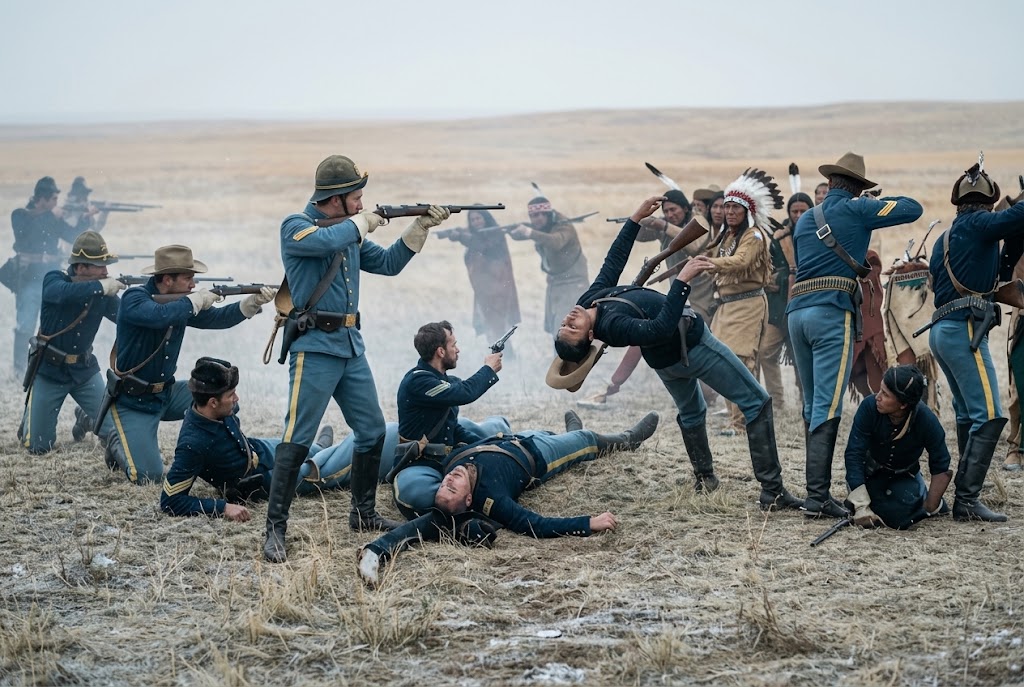
Soldiers moved through the Lakota camp on the morning of December 29 collecting rifles and other weapons, a tense process complicated by the army’s demand that even ceremonial and hunting implements be surrendered, and by a search of individual Lakota men that many considered a humiliation. Accounts differ on precisely how the shooting began, but most describe a struggle over a rifle held by a deaf Lakota man named Black Coyote, who reportedly did not understand orders to surrender his weapon, resulting in a single shot that soldiers stationed on the surrounding hillsides answered with a general volley into the camp below. The four Hotchkiss guns positioned on the high ground immediately opened fire on the camp at a rate of nearly fifty rounds per minute, shredding the tipis and cutting down men, women, and children indiscriminately in the initial barrage before survivors could even attempt to flee. Lakota men who had already been disarmed fought back with knives, clubs, and whatever weapons they could seize from fallen soldiers, buying time for some family members to escape the initial chaos even as they themselves were cut down in the effort.
Eyewitness accounts describe soldiers pursuing fleeing women and children for miles across the surrounding ravines and prairie, killing many of them far from the original camp in what survivors and later investigators described as a running slaughter rather than a contained exchange of fire. Some of the wounded who managed to hide in ravines or under brush lay in the freezing cold for hours or days before being found, and several infants were later discovered still alive beside their dead mothers, having been shielded from the gunfire and the cold by their mothers’ bodies. Oglala holy man Black Elk arrived at the scene shortly after the shooting and later described finding the dead, including many women and children, scattered across the snow-covered landscape in the massacre’s aftermath. A blizzard swept through the region in the days that followed, delaying the recovery of bodies, and when burial parties finally returned, they found frozen corpses still lying where they had fallen, which they buried in a single mass grave atop a hill overlooking the camp.
Estimates of the dead range from roughly 150 to nearly 300 Lakota men, women, and children, though the exact toll has never been definitively established given how many bodies were never recovered from the surrounding terrain, while the Army reported twenty-five soldiers killed, a number of whom were likely struck by the crossfire of their own Hotchkiss guns. Twenty soldiers involved in the killing were later awarded the Medal of Honor, a decision that survivors, descendants, and many historians have long argued should be rescinded given the nature of what occurred, a formal review of which remained ongoing within the federal government decades later. Wounded soldiers and a small number of Lakota survivors were transported afterward to a makeshift hospital established at the Pine Ridge Agency, where an Episcopal mission church had its pews removed to make room for the wounded, arriving on Christmas week under a banner that read “Peace on Earth, Good Will to Men” still hanging from the rafters.
The Legacy of Wounded Knee
Wounded Knee is widely regarded by historians as the effective end of the armed conflicts between the United States government and Plains Indian nations, closing the broader period known as the Indian Wars with the same brutal military overmatch that had characterized much of the preceding decades. The massacre became a defining symbol of the U.S. government’s treatment of Native Americans, referenced repeatedly in the twentieth century by Native rights activists, most visibly during the 1973 occupation of the same site by members of the American Indian Movement protesting ongoing injustices, an occupation that lasted seventy-one days and drew renewed national attention to the original massacre’s unresolved legacy. Survivors and their descendants have spent more than a century seeking formal acknowledgment and rescission of the Medal of Honor awards, and the effort to recognize the event fully as a massacre rather than a battle continues to shape how the site and its history are presented today, decades after the U.S. Congress issued a formal statement of regret over the killings in 1990.
What Remains at Wounded Knee
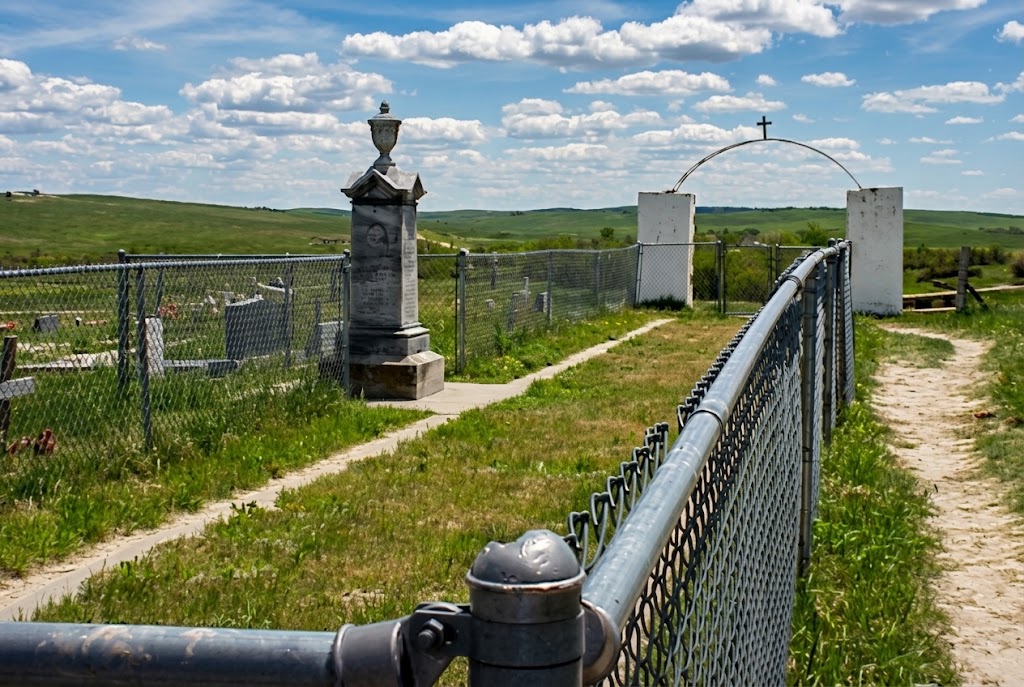
The massacre site sits on the Pine Ridge Indian Reservation rather than within the National Park Service system, and in December 2025 the 40 acres surrounding the mass grave were placed into restricted tribal title jointly held by the Oglala Sioux and Cheyenne River Sioux Tribes, ending decades of contested private ownership of the ground itself. A hilltop cemetery holds a stone monument erected in 1903 listing the names of those killed, along with a roadside informational plaque nearby, but there is no formal visitor center at the site, and the separate Wounded Knee Museum that once operated in Wall, South Dakota, has since closed. Entry to the site is free, though a personal vehicle is necessary, since the location is remote with very limited services or nearby lodging, and site management is actively transitioning to tribal control following the 2025 land settlement.
This remains an active place of mourning and an active mass grave for Lakota descendants rather than a neutral historical attraction, and visitors should approach it with particular discretion, especially regarding photography near the graves themselves, and should treat any local vendors they encounter with respect. Because oversight of the site continues to shift toward the Oglala Sioux and Cheyenne River Sioux Tribes, visitors are encouraged to check current tribal guidance before planning a visit, both as a matter of practical logistics and as a sign of respect for the community for whom this ground remains sacred. The 2025 transfer of title marked the culmination of a long campaign by Lakota descendants to reclaim direct authority over the ground where their ancestors are buried, following decades in which the site’s ownership remained fragmented among private landholders.
Remembrance of Wounded Knee
Black Elk, an Oglala Lakota holy man, arrived at the scene shortly after the massacre and described finding the dead, including many women and children, scattered in the snow, an account preserved in the 1932 book “Black Elk Speaks” and in a more literal transcription of his testimony published decades later. Dewey Beard, known also as Iron Hail, a Miniconjou Lakota survivor who lost his parents, wife, and infant child in the massacre, gave testimony about the event multiple times over the course of his long life, living until 1955 as one of the last surviving witnesses. Joseph Horn Cloud, a Lakota survivor whose family was killed in the massacre, became a lifelong advocate for survivors afterward, helping found the Wounded Knee Survivors Association and pressing Congress for reparations on their behalf for decades. Taken together, these three accounts, a holy man’s testimony of the scene’s immediate aftermath, a survivor’s lifelong recounting of personal loss, and another survivor’s decades-long advocacy for recognition and reparations, preserve Wounded Knee through the voices of the Lakota people who lived through it and carried its memory forward, rather than through the official military reports that for decades framed the killings as a battle rather than the massacre their own testimony makes unmistakably clear.
Further Exploration: Documentary titled “We Shall Remain: Wounded Knee” (PBS American Experience, 2009)
Location: Wounded Knee Massacre Memorial, BIA Highway 27, near Porcupine, South Dakota (Pine Ridge Indian Reservation)
Site Status: Marker or Monument Only
Visitation Notes: Not a National Park Service unit — the massacre site sits on the Pine Ridge Indian Reservation, and in December 2025 the 40 acres surrounding the mass grave were placed into restricted tribal title jointly held by the Oglala Sioux and Cheyenne River Sioux Tribes, ending decades of contested private ownership. A hilltop cemetery holds a 1903 stone monument, with a roadside informational plaque nearby; there is no formal visitor center on site, and the separate Wounded Knee Museum in Wall, SD, has closed. Entry is free; a personal vehicle is required, as the site is remote with very limited nearby services. This is an active place of mourning and an active mass grave for Lakota descendants, not a neutral tourist attraction — visitors should be discreet with photography, especially near the graves, and treat local vendors respectfully. Because site management is actively transitioning to tribal control, visitors should check current Oglala Sioux Tribe and Cheyenne River Sioux Tribe guidance before visiting.
Google Map
Visitor Comments
A visitor identified as Capt R described being approached by aggressive vendors and solicitors almost immediately after arriving, which left them feeling unsafe enough that they left without fully viewing the memorial.
— from TripAdvisor
A visitor going by Cocker reported a similar experience, saying panhandlers approached as soon as they parked; his wife chose to stay in the car for the entire visit out of safety concerns.
— from TripAdvisor
Lynn C. found the site’s guides friendly and knowledgeable, noting that the memorial’s modest upkeep reflects its location on one of the poorest reservations in the United States.
— from TripAdvisor
A visitor writing as christineetcie2016 described the atmosphere as moving, appreciating that commercialization was kept to a minimum, with only a few Lakota vendors selling handcrafted jewelry near the roadside sign.
— from TripAdvisor