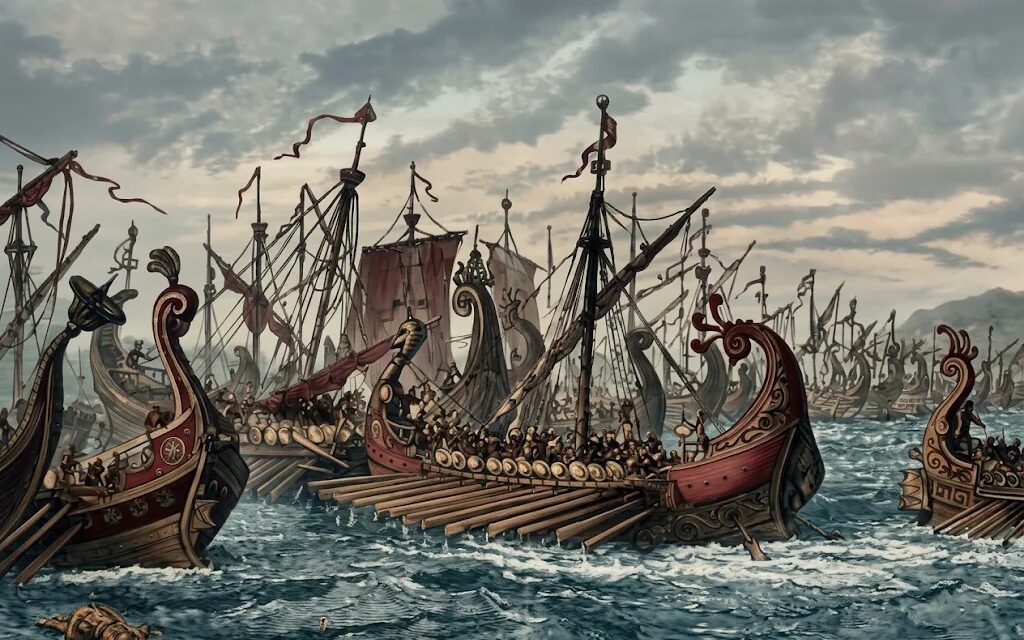
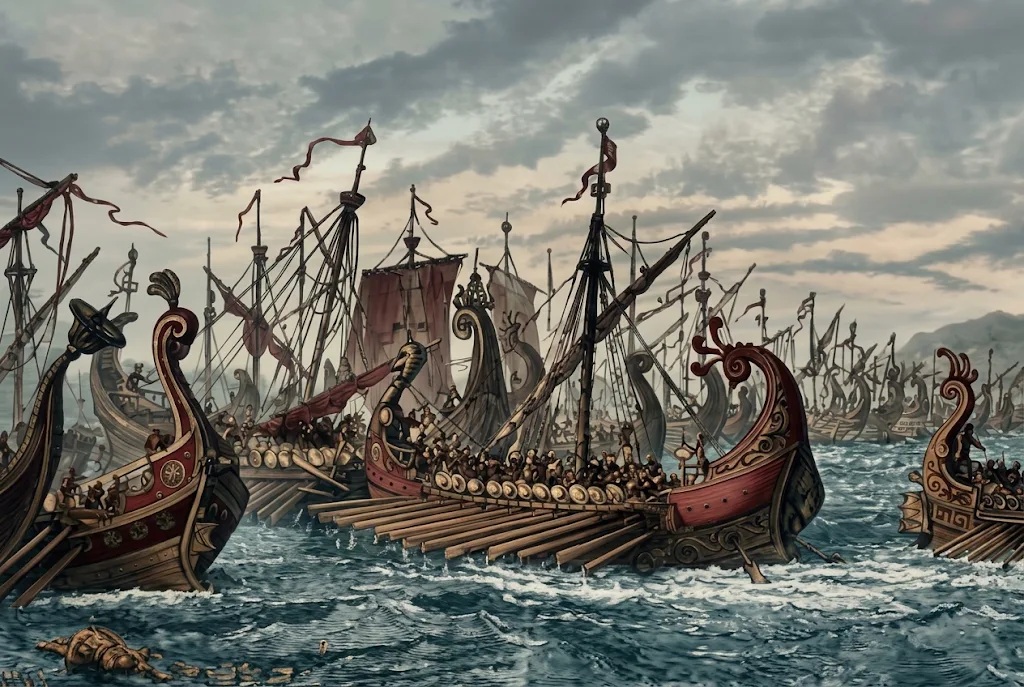
Fleeing an Athenian warship in the chaos of battle, Artemisia I of Caria rammed and sank a fellow Persian vessel to clear her escape route, and the ruse worked better than she could have hoped. Watching from a golden throne on the shore, King Xerxes saw only a ship of his own fleet sinking an enemy vessel and praised her as his bravest commander that day, never realizing the ship she had sunk was his own. It was a fitting, almost absurd detail for a battle built entirely on deception, since the entire Persian fleet had been lured into the narrow strait by a Greek lie in the first place, and by evening it lay shattered on the rocks of Salamis.
Salamis: The Road to Battle
By September 480 BC, King Xerxes I of Persia had already burned an evacuated Athens and stood at the height of his invasion of Greece, commanding a fleet of several hundred warships against a much smaller allied Greek force gathered in the narrow strait between the mainland and the island of Salamis. The Greek commanders, led nominally by the Spartan Eurybiades but dominated in practice by the shrewd Athenian statesman Themistocles, were bitterly divided over strategy, with several allied contingents pushing to withdraw southward to defend the Isthmus of Corinth rather than risk a decisive battle so close to a fallen capital. Themistocles, convinced that only the cramped waters of the Salamis strait could neutralize the Persians’ overwhelming numerical advantage, resorted to a calculated gamble to force the issue before the Greek alliance could dissolve into retreat.
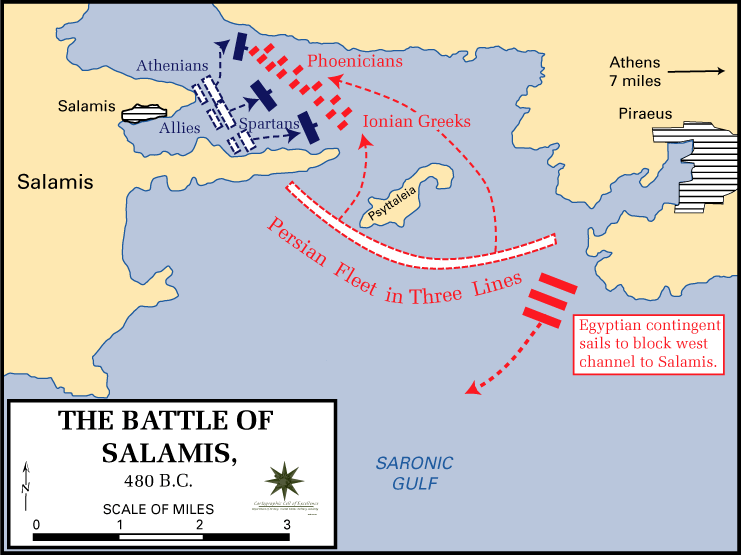
He secretly sent his household servant Sicinnus across the water to Xerxes with a false message, claiming that the Greek fleet was demoralized, divided, and preparing to slip away under cover of darkness, and urging the Persian king to seal the strait’s exits immediately to trap them. Xerxes, eager to end the campaign with a single crushing naval victory and wary of losing his enemy to a nighttime withdrawal, took the bait completely, ordering his fleet to advance into the strait during the night and block both ends against escape. This decision committed hundreds of Persian and allied Phoenician, Egyptian, and Ionian ships to fighting in confined waters where their superior numbers would count for little and their ships, generally larger and less maneuverable than the Greek triremes, would struggle to turn and regroup. As dawn broke on the day of battle, the Persian fleet found itself already inside the trap Themistocles had set, crowded into the strait with no room to exploit its numerical superiority, while the more nimble Greek triremes waited in the open water beyond, ready to exploit the confusion that was certain to follow.
The Battle of Salamis
As the Persian fleet pressed into the strait in the early morning, the Greek triremes advanced in disciplined order, drawing the leading Persian ships deeper into the confined waters before turning to engage them directly, a tactic that immediately began to crowd the Persian formation and rob it of any room to maneuver. Ships toward the rear of the Persian fleet, still trying to press forward into the strait, collided with vessels ahead of them that had already stalled or begun to founder, turning what should have been an overwhelming numerical advantage into a chaotic traffic jam of warships unable to bring their full force to bear. The lighter, more maneuverable Greek triremes exploited this confusion mercilessly, ramming into the sides and sterns of Persian ships with their bronze-plated rams, a tactic that proved devastatingly effective against vessels that had no space to turn and present a narrower profile. Xerxes himself watched the unfolding disaster from a golden throne set up on the slopes of Mount Aegaleo overlooking the strait, having positioned himself there specifically to observe which of his commanders distinguished themselves in what he expected to be a decisive Persian victory.
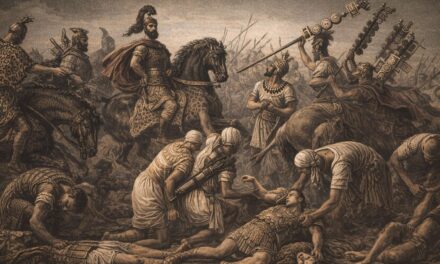
It was during this fighting that Artemisia I of Caria, one of the few named female naval commanders of antiquity and a trusted ally of Xerxes, found her ship pursued closely by an Athenian vessel with no clear path of escape through the crowded strait. In a moment of ruthless improvisation, she turned and rammed a nearby ship from her own allied fleet, sinking it outright, a maneuver that convinced her Athenian pursuer she must be a Greek ally and caused him to break off the chase, allowing her to escape the melee entirely. Xerxes, watching from his hillside vantage point and unable to tell at such a distance that the sunk ship belonged to his own side, reportedly remarked that his men had become women and his women had become men that day, singling out Artemisia for praise despite what had actually just occurred.
As the battle wore on through the day, the cumulative effect of ship after Persian ship becoming trapped, rammed, or driven onto the rocky shoreline of Salamis proved catastrophic, with allied contingents further back in the formation unable to retreat through the press of their own vessels behind them. By late afternoon, the Persian fleet had suffered devastating losses, with hundreds of ships sunk, captured, or driven ashore, while Greek losses remained comparatively light thanks to the tactical advantages of fighting in familiar, confined waters against an enemy robbed of its numerical edge. Survivors from wrecked and sinking Persian ships who managed to reach the shoreline of Salamis itself fared little better, since Greek forces stationed on the island moved in to kill or capture many of the stranded sailors and marines as they struggled out of the water, denying Xerxes even the consolation of recovering his crews for another engagement. The scale of the defeat, witnessed personally by the Persian king from his shoreline throne, transformed what Xerxes had expected to be a triumphant final blow against the Greek resistance into one of the most lopsided naval disasters of the ancient world.
The Legacy of Salamis
The catastrophic defeat at Salamis, witnessed firsthand by Xerxes himself, so shook the Persian king’s confidence in the campaign that he withdrew the bulk of his army from Greece not long afterward, leaving a reduced force under his general Mardonius to continue the invasion the following year. The battle is widely regarded by historians as the turning point of the Greco-Persian Wars, preserving the independence of the Greek city-states and, by extension, shaping the subsequent development of Greek political and cultural life that would influence Western civilization for centuries. Themistocles’ calculated gamble in luring the Persian fleet into the strait through deliberate deception became one of antiquity’s most celebrated examples of strategic deception overcoming overwhelming material superiority. Artemisia’s dramatic escape, and Xerxes’ unwitting praise for an act that was in truth a betrayal of his own fleet, endures as one of the battle’s strangest and most frequently retold anecdotes. The following year, the reduced Persian force left under Mardonius was decisively defeated on land at Plataea, a battle that, together with Salamis, effectively ended the Persian threat to Greece and allowed Athens to enter the flourishing later ages would remember as its golden age.
Visiting Salamis Today
Because Salamis was fought entirely at sea, there is no land battlefield in the traditional sense for visitors to walk, and the strait itself remains open water largely unchanged in its basic geography since antiquity, reachable today by short ferry crossings from the ports of Perama or Piraeus to the island of Salamis. The Archaeological Museum of Salamis offers visitors a dedicated gallery exploring the battle’s key figures and the strategic thinking behind Themistocles’ gamble, providing essential historical context that the open water alone cannot convey. A bronze monument overlooking the strait marks the general site of the battle, though visitors reviewing the marker note that it carries no inscriptions or interpretive signage explaining its significance, leaving much of the historical weight to be supplied by prior knowledge rather than on-site information.
Herodotus records that Xerxes watched the battle from a throne set up on the slopes of Mount Aegaleo, and while the most likely candidate for that specific vantage point today sits inside an active Greek naval base with restricted public access, a separate public hiking trail in the same general area shares the mountain’s name, a detail worth verifying carefully before planning a visit around it. Because so much of the battle’s drama unfolded on the water itself rather than on any fixed piece of land, a visit to Salamis today rewards travelers who take the ferry crossing itself as part of the experience, looking out over the strait’s calm modern surface while imagining the chaos of rammed and burning ships that once filled it. The Attica coastline surrounding the strait, including views back toward Piraeus and Athens, offers a striking sense of just how close this pivotal naval engagement unfolded to the Greek capital that Xerxes had already captured and burned. Visitors hoping for a conventional walkable battlefield park should adjust their expectations accordingly, treating Salamis instead as a landscape best appreciated through its museum context and the open water itself rather than through preserved fortifications or trench lines.
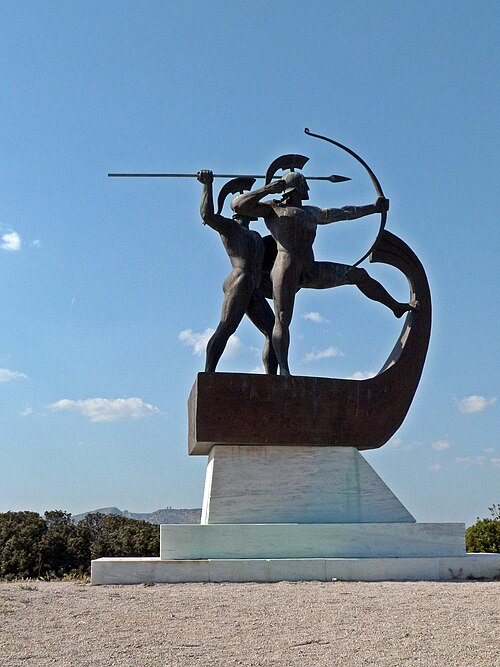
Remembrance of Salamis
Herodotus’s account remains the primary ancient source for the battle, and his description of Xerxes observing the fighting from Mount Aegaleo, along with his record of Artemisia’s daring escape and the king’s mistaken praise, continues to shape how historians and visitors alike understand the day’s events more than two millennia later. The Archaeological Museum of Salamis has worked to preserve public understanding of the battle’s strategic complexity despite the total absence of a physical battlefield to explore, anchoring the site’s modern commemoration in scholarship and artifact rather than terrain. The story of Themistocles’ deception, and Artemisia’s inadvertent, self-serving act of destruction against her own fleet becoming legend as an act of heroism, together capture the peculiar blend of cunning, chaos, and reversed fortune that has made Salamis one of antiquity’s most enduringly retold naval engagements. That the strait itself remains recognizable water, still crossed daily by ordinary ferry traffic between Piraeus and Salamis, gives modern visitors an unusually direct physical connection to the setting of a battle whose consequences reshaped the ancient world.
Further Exploration: Book titled “The Battle of Salamis: The Naval Encounter That Saved Greece — and Western Civilization” by Barry Strauss (Simon & Schuster, 2004)
Location: Archaeological Museum of Salamis, Salamis Island (Salamina), Greece (reached by ferry from Perama/Piraeus to Paloukia port; the battle was fought in the open strait between the island and the Attic mainland, so there is no single land battlefield site)
Site Status: Marker or Monument Only
Visitation Notes: As a naval battle, there is no land battlefield to walk — the strait itself is unchanged open water, reachable by ferry from Perama or Piraeus to the island of Salamis. The Archaeological Museum of Salamis has a gallery on the battle’s key figures and strategy, and a bronze monument overlooking the strait marks the site, though reviewers note it has no inscriptions or interpretive signage. Herodotus places Xerxes’ viewing throne on the slopes of Mount Aegaleo; the most likely spot sits inside an active Greek naval base with restricted access, though a separate public hiking trail in the area shares the same name — worth verifying locally before planning a visit around it.
Google Map
Visitor Comments
Berthaki calls it “a hidden jewel,” noting it displays objects from the first occupation of the island through the classical period.
— from TripAdvisor
FourWindsBar describes it as “a wonderful little museum housed in a neat building with 3 modern and well laid out galleries.”
— from TripAdvisor
Rosaria L praises it as “small but very interesting,” adding that “the staff was very kind” and the materials are well displayed.
— from TripAdvisor