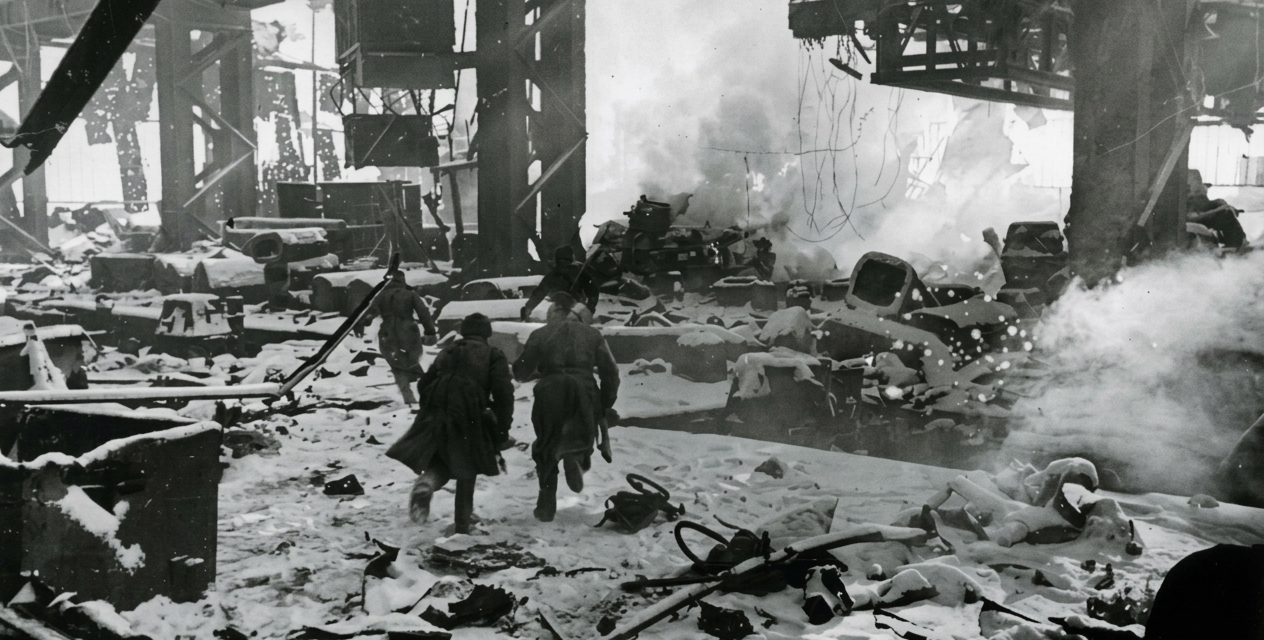
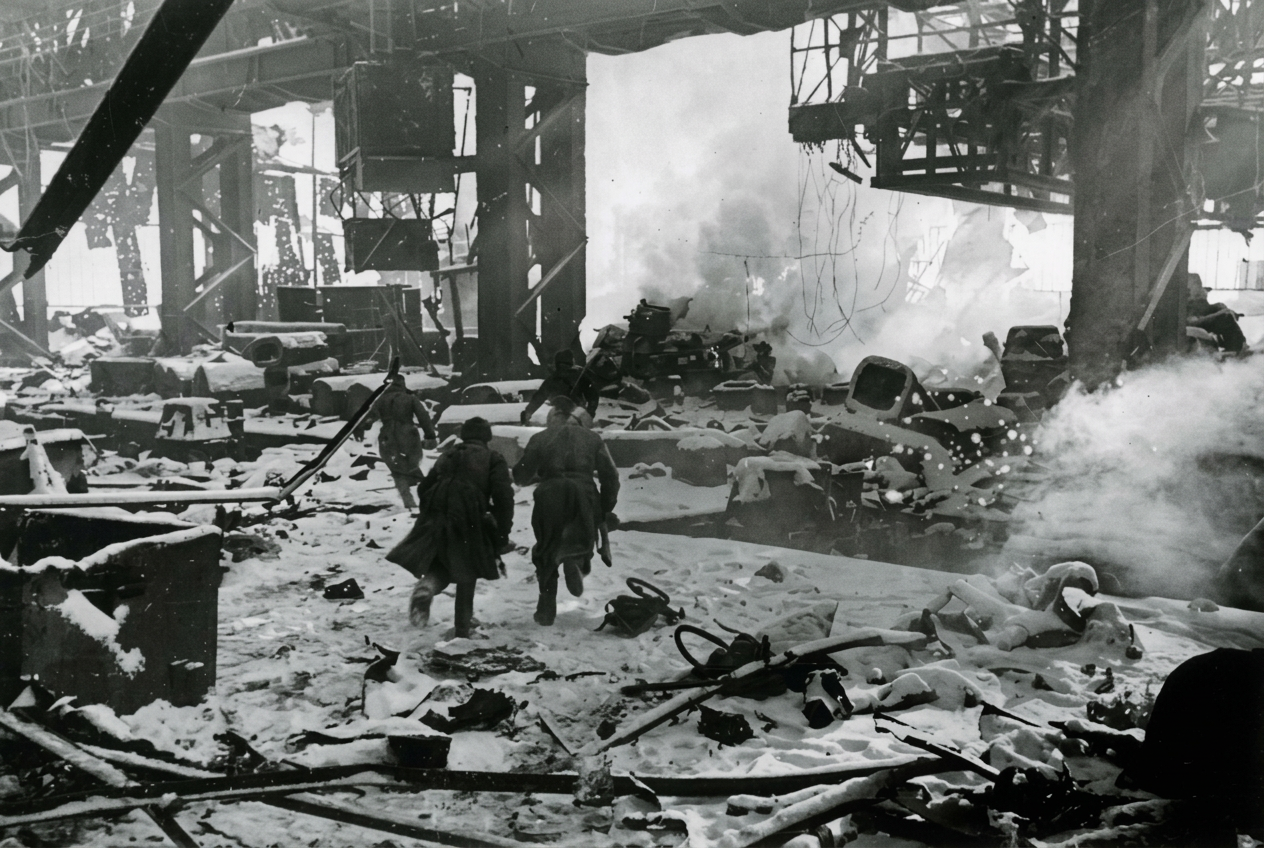
The building had no roof left, only a stairwell holding up half of what remained, and it changed hands three times before the sun went down. German soldiers pushed through a courtyard strewn with brick dust and shell casings, certain they had finally taken the block, only to be driven back out by a counterattack that came from a cellar nobody had checked. By late 1942 this had become the daily arithmetic of the fighting along the Volga: doorways counted as front lines, floors of the same apartment block changed hands independently of the floors above and below them, and a single grain elevator or railway station could occupy two armies for weeks at a time. Soldiers on both sides had a grim name for it — the rat war, fought room by room until neither army could say with certainty who held what.
Battle of Stalingrad: The Road to Battle
By the summer of 1942, Hitler’s invasion of the Soviet Union had stalled well short of its original objectives, and German planners shifted their ambitions south in an operation codenamed Case Blue. Its primary aim was to seize the oil fields of the Caucasus, which German war planners believed were essential to sustaining the wider invasion and, eventually, the entire German war economy. The city on the Volga bearing Stalin’s own name was meant to be a secondary objective within that plan — a flank-guarding position to be taken quickly before the main thrust continued toward the oil fields further south. Its industrial base, its rail and river junctions, and its symbolic weight as a namesake city made it a target neither side could easily walk away from once the fighting began in earnest.
Army Group B’s Sixth Army, commanded by General Friedrich Paulus, reached the outskirts of Stalingrad in August 1942 backed by punishing Luftwaffe air raids that reduced much of the city center to rubble within days, killing thousands of civilians who had not yet been evacuated across the Volga. Stalin, unwilling to cede a city bearing his own name and determined to hold the Volga as a supply artery for the wider Soviet war effort, issued Order No. 227 — popularly known as “Not one step back” — making unauthorized retreat from the city a court-martial offense enforced by dedicated blocking detachments stationed behind the front line. What both sides had initially expected to be a swift battle for a secondary objective instead became the fight that would come to define the entire Eastern Front and, arguably, the outcome of the war in Europe. Neither Hitler nor Stalin had planned for the city to become the war’s central battle, but each escalated his commitment to it as the fighting dragged on, until withdrawing became politically unthinkable for both governments regardless of the military cost.
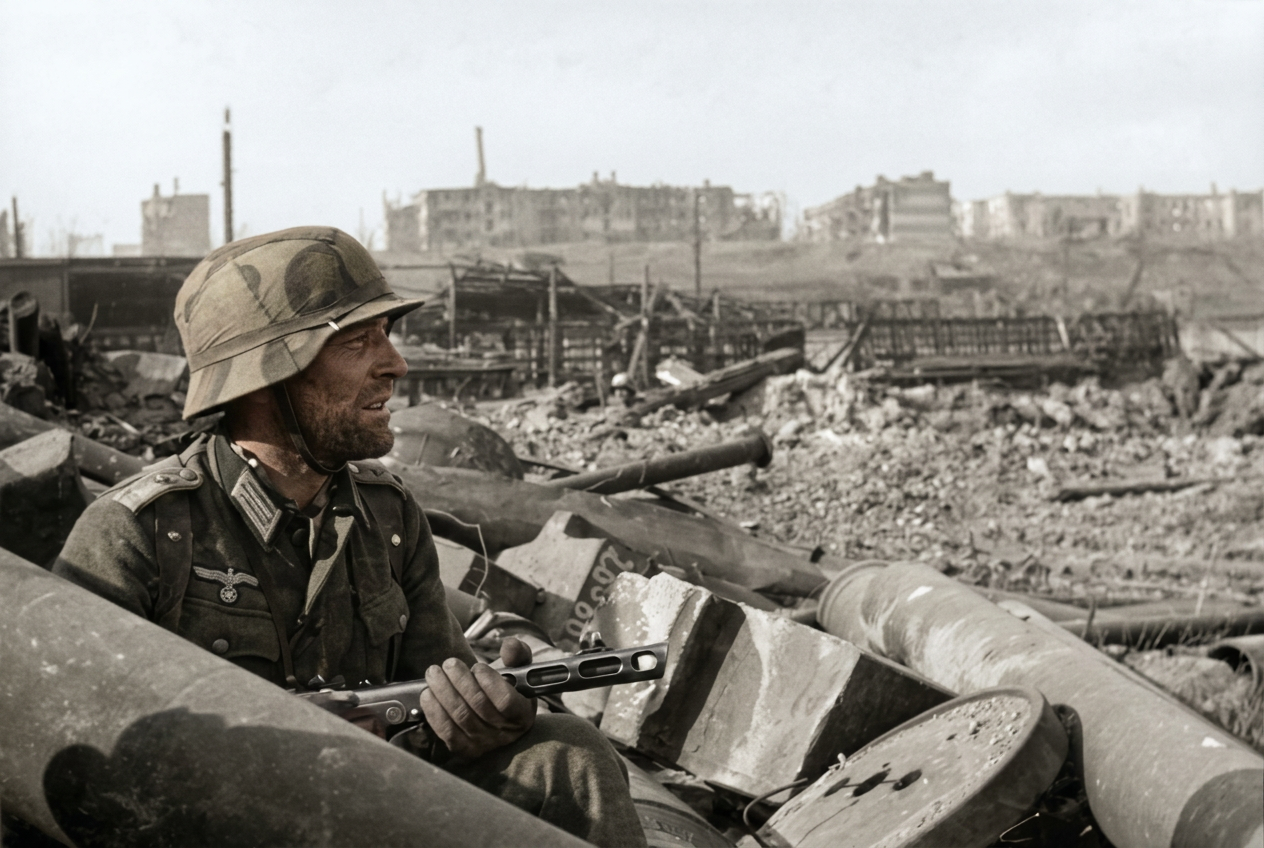
The Battle of Stalingrad
German troops entered the city in September 1942 expecting to clear it within days; instead they found themselves fighting for individual buildings, floors, and stairwells against a Soviet 62nd Army determined not to yield the western bank of the Volga at any cost. One apartment block near the central train station, defended by a small Soviet garrison for nearly two months against repeated German assaults, became so notorious that soldiers on both sides simply called it Pavlov’s House. Vasily Grossman, a war correspondent for the Red Army newspaper Krasnaya Zvezda who spent months embedded with the 62nd Army inside the city, filed dispatches describing exactly this kind of fighting — small garrisons holding fragments of buildings while the front line itself dissolved into a maze of shattered walls, rubble-choked stairwells, and cellars fought over floor by floor.
The grinding pace of the fighting showed clearly in the letters soldiers on both sides sent home during the siege. Walter Oppermann, a German private first class, wrote to his brother in November 1942 that his unit had spent an entire day fighting to gain twenty meters of ground, only for a Soviet counterattack to retake it the same night — a single sentence that captured the war of attrition the whole battle had become for the men fighting it. Lieutenant General Vasily Chuikov, the Soviet commander tasked with defending the city, later recalled in his postwar memoir ordering his men to hold the Volga riverbank at any cost and to contest the German Sixth Army building by building rather than concede territory, a strategy that turned the city into precisely the meat grinder both Oppermann’s letter and Grossman’s dispatches described from opposite sides of the same line.
The turning point came not inside the city itself but around it. On November 19, 1942, the Red Army launched Operation Uranus, a pincer offensive that broke through the weaker Romanian and Hungarian formations guarding the Sixth Army’s flanks and closed the encirclement within days, trapping some 250,000 Axis troops inside and around the city. German attempts to relieve the pocket from outside, including an armored thrust codenamed Operation Winter Storm, failed to break through the Soviet ring, and conditions inside the encirclement collapsed through the winter as supplies dwindled to a trickle flown in by an overstretched and increasingly costly Luftwaffe airlift that lost hundreds of transport aircraft trying to keep the trapped army fed and armed. Temperatures fell well below freezing, wounds went untreated for lack of medical supplies, and starvation set in alongside the fighting itself for the men still holding the line inside the pocket. Otto Zechtig, a German soldier of the 227th Infantry Regiment, wrote home in late December describing his unit reduced to eating dogs and scavenging for whatever wildlife remained as rations ran out entirely inside the pocket. Paulus surrendered the remnants of his army on February 2, 1943, in direct defiance of Hitler’s explicit order to fight to the last man and the last bullet, closing one of the costliest battles of the entire war. Of roughly 91,000 German and Axis troops taken prisoner in the surrender, only a small fraction would survive Soviet captivity to eventually return home years later.
The Legacy of Stalingrad
Stalingrad marked the first major surrender of a German field army in the Second World War and the definitive end of Germany’s strategic initiative on the Eastern Front. The destruction of the Sixth Army — one of the Wehrmacht’s largest and most experienced formations — shattered the myth of German invincibility that had held since the invasion began in 1941, handed the Soviet Union the momentum it would carry all the way to Berlin over the following two years, and cost both sides a combined death toll estimated well into the hundreds of thousands. Few battles carry as much weight in shaping a war’s outcome, or as much cost in the ground where they were fought. What began as a secondary objective in a campaign aimed at oil fields further south ended as the grave of an entire German army — proof that neither side fully controls how large a battle becomes once national pride gets tangled up in the fighting.
Visiting Mamayev Kurgan Today
The battle’s memory is preserved today at Mamayev Kurgan, a hill overlooking Volgograd (renamed from Stalingrad in 1961) that saw some of the war’s fiercest and most sustained fighting, since whoever held its high ground could direct artillery fire across much of the city and the Volga below. The hill now anchors Volgograd’s memorial complex and is dominated by the Motherland Calls statue, one of the tallest sculptures in the world at the time of its completion, its raised sword visible from much of the surrounding city and from boats passing on the river. Visitors climb a long stepped ascent, numbering exactly two hundred steps to mark the two hundred days of the battle, past memorial walls inscribed with names of the fallen, an eternal flame, and a hall of military glory before finally reaching the statue itself at the summit.
The adjoining Panorama Museum of the Battle of Stalingrad houses a large circular painting depicting the battle in 360 degrees alongside weapons, uniforms, maps, and personal artifacts recovered from the fighting and donated by veterans and their families over the decades since. Mamayev Kurgan itself is open around the clock with free admission, while the Panorama Museum keeps standard daytime hours and can be joined on a guided tour arranged on-site for visitors who want more context than the exhibits alone provide. Late spring through early autumn is the most comfortable season for the long climb up the Kurgan, since the site offers little shelter from Volgograd’s harsh winters, and no advance booking is required for a general visit to the hill itself.
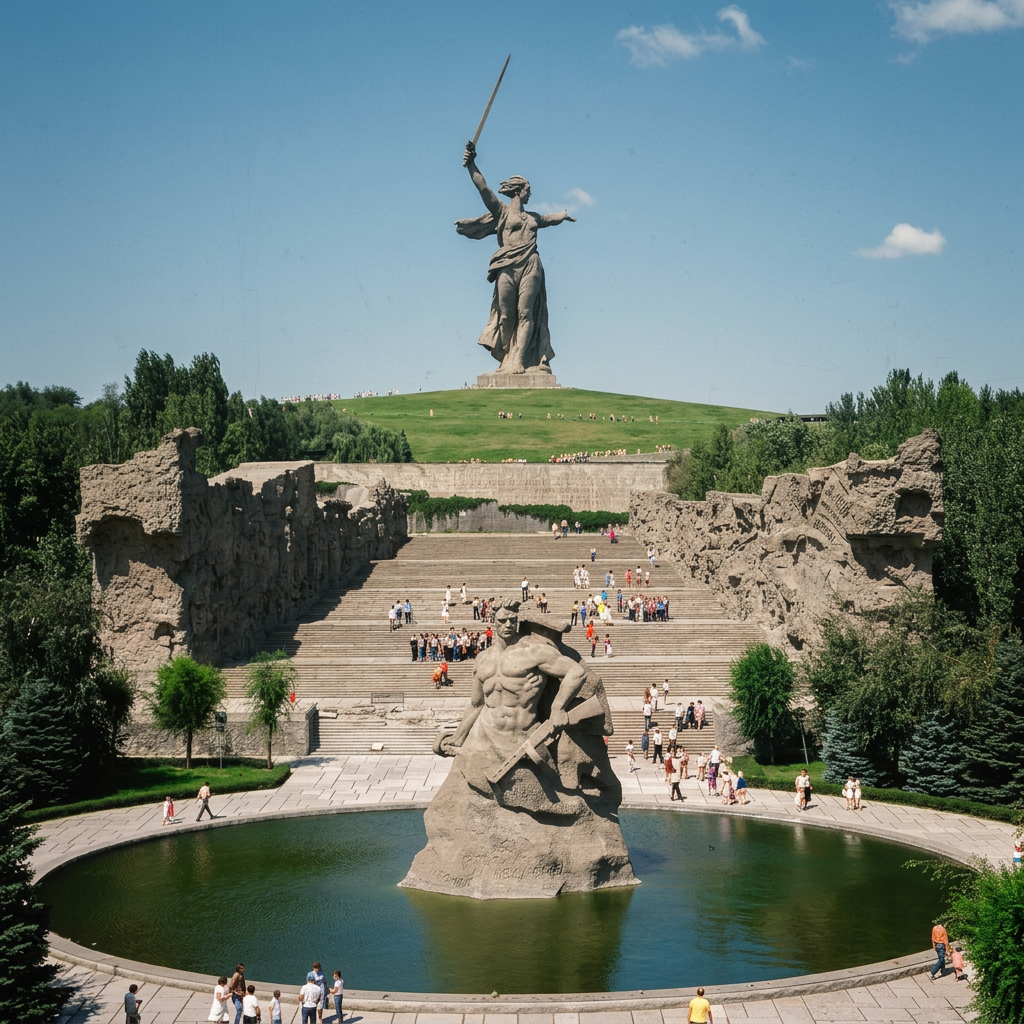
Remembrance at Mamayev Kurgan
Russia marks the anniversary of the battle’s end every February 2 with a formal wreath-laying ceremony at Mamayev Kurgan, drawing veterans, government officials, and residents of Volgograd to the memorial in the depth of winter, much as the battle itself was fought and finally decided in the cold. The eternal flame at the base of the hill and the long roll call of names inscribed on the site’s memorial walls keep the scale of the loss present for visitors throughout the year, not only on the anniversary itself. For a city that was almost entirely leveled in the fighting and rebuilt from ruins afterward, the Kurgan functions as both a war memorial and a piece of civic identity built around what Volgograd endured and ultimately survived. School groups, foreign veterans’ delegations, and descendants of soldiers who fought there make up much of the traffic outside the February ceremony itself, and a changing-of-the-guard ritual is performed at the eternal flame throughout the year.
Visitor Info: stalingrad-battle.ru — official website of the State Museum-Reserve Stalingrad Battle, which operates the Panorama Museum and the Mamayev Kurgan memorial complex.
Location: Mamayev Kurgan Memorial Complex, Volgograd, Volgograd Oblast, 400001, Russia
Site Status: National Park / Managed Historic Site
Visitation Notes: The battlefield lies within the present-day city of Volgograd, where the Mamayev Kurgan hill and the adjoining Panorama Museum of the Battle of Stalingrad form the core memorial complex. The Kurgan is open 24 hours with free admission, while the museum keeps standard daytime hours; late spring through early autumn is the most comfortable season for the long stepped ascent past the Motherland Calls statue. Russia marks the battle’s end every February 2 with a wreath-laying ceremony at the site. No advance booking is required, though guided tours can be arranged through the museum.
Google Map
Firsthand Accounts
The memorial conveys just how much the Soviet victory cost — the statues struck one visitor as magnificent and the scale of sacrifice as monumental, an impression that stays with you well after leaving the hill.
— from TripAdvisor
Andrew90545 called it the most impressive place they had ever been, saying it was humbling to stand where fascism was stopped and calling it well worth the trip.
— from TripAdvisor
A Wanderlog guide entry recommends visiting after dark, when the memorial is well lit, and describes the site as functioning like an open-air museum — the Motherland Calls statue, reflecting pool, stone reliefs, and Hall of Glory combining to leave visitors with a strong sense of the site’s historical weight.
— from Wanderlog
Atlas Obscura describes the Motherland Calls statue as the dramatic centerpiece of the memorial complex atop Mamayev Kurgan, noting it briefly held the record for tallest statue in the world and remains the tallest statue of a woman anywhere — a scale that’s genuinely hard to register until standing at its base.
— from Atlas Obscura