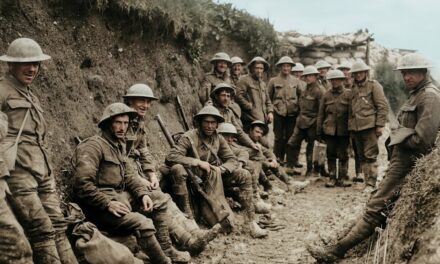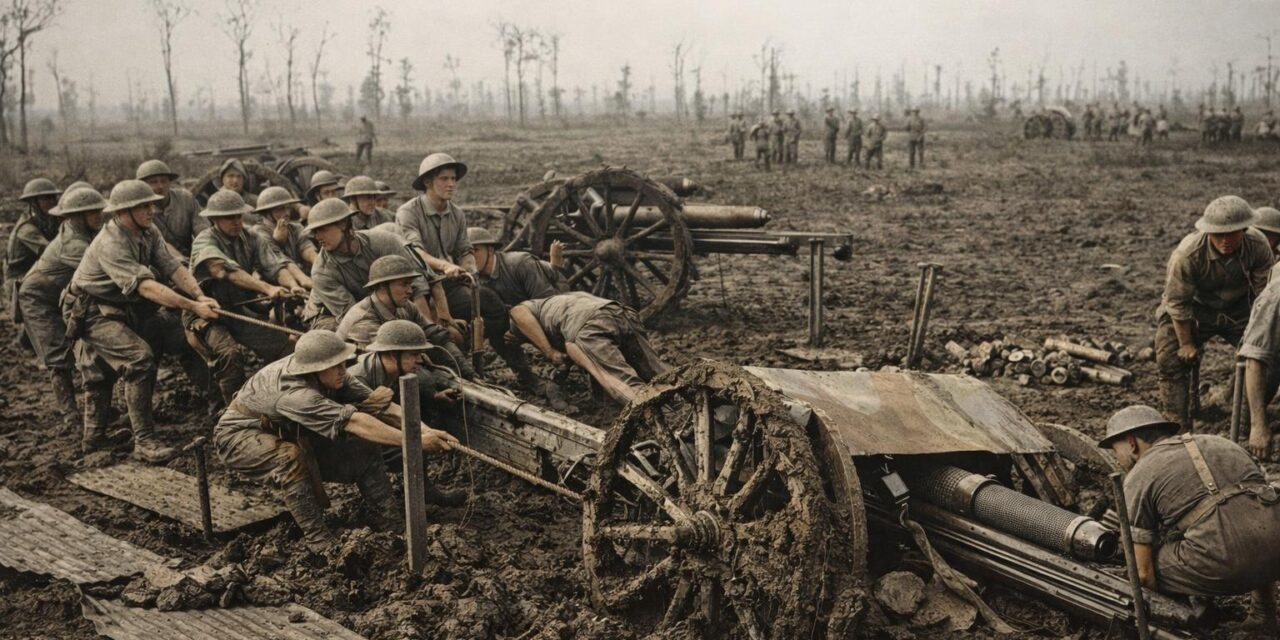
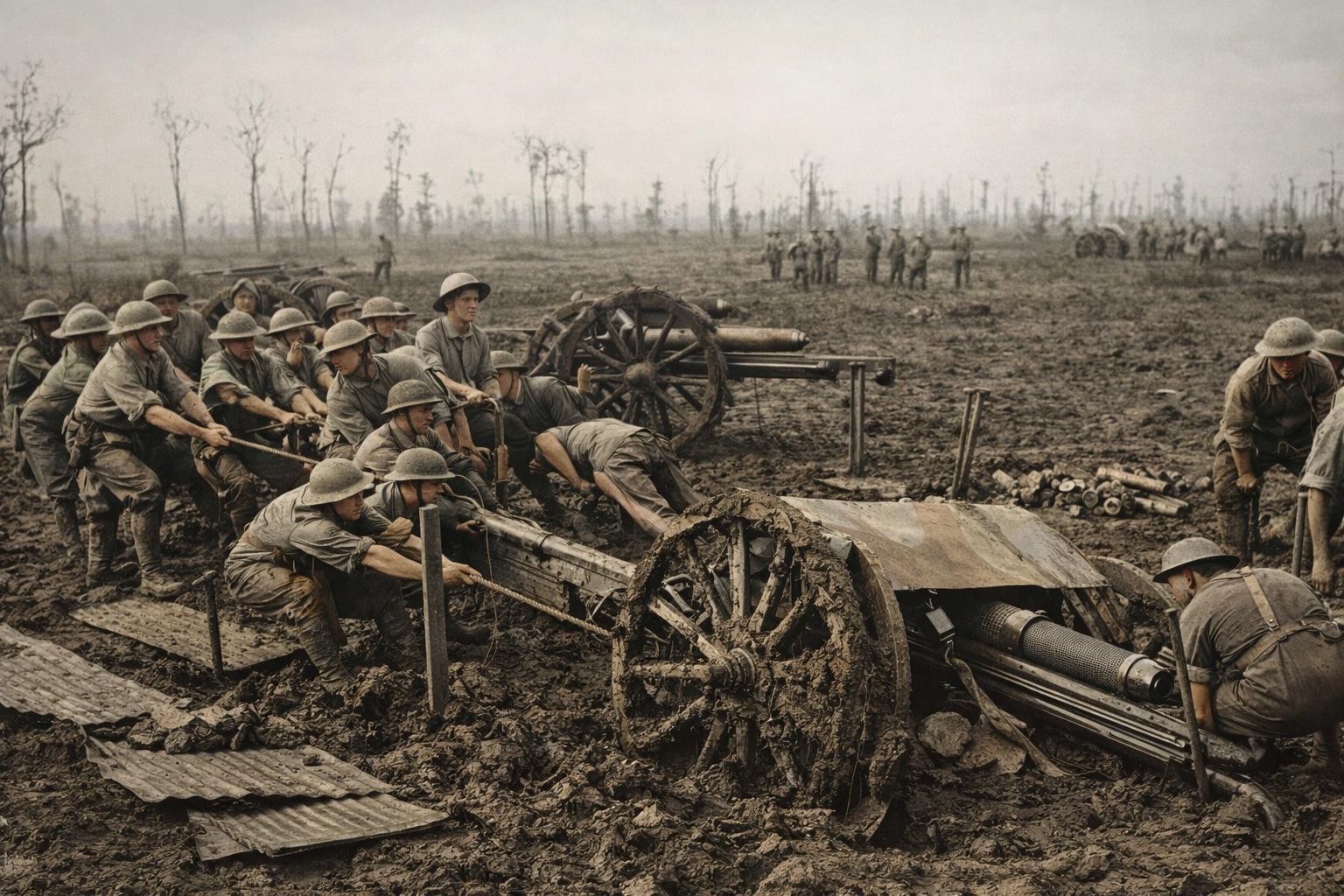
Men waded forward through mud that had swallowed roads, trenches, and in places entire gun batteries, each step sinking to the knee or deeper in ground churned by three months of shellfire and the heaviest rains Flanders had seen in decades. Wounded soldiers who slipped from the narrow duckboard tracks laid down through the wire drowned within sight of their comrades, who could do nothing to reach them without abandoning the advance themselves. Artillery pieces dragged forward to support the next push sank to their axles and had to be abandoned where they stood, and runners carrying messages between the front and the rear sometimes took hours to cover a few hundred yards of shattered ground. By the time New Zealand troops reached the base of Bellevue Spur on October 12, 1917, the ridge above them was studded with concrete bunkers whose machine guns had already cut down two earlier assaults that month, and the mud itself had become as lethal an adversary as the German defenders waiting above.
Battle of Passchendaele: The Road to Battle
By mid-1917, British Commander-in-Chief Sir Douglas Haig had settled on Flanders as the site for a major offensive intended to break the deadlock of trench warfare on the Western Front. Haig hoped a breakthrough near Ypres could clear German U-boat bases on the Belgian coast at Ostend and Zeebrugge, ease pressure on France’s exhausted army following the mutinies that spring, and wear down German reserves through sustained attrition. The town of Ypres itself, and the low ridges surrounding it known as the Ypres Salient, had already been fought over twice before, in 1914 and 1915, leaving the ground pitted with shell craters and the wider Salient one of the most heavily contested stretches of the entire front. Haig also believed, based on intelligence that overstated German exhaustion after the bloodletting at Verdun and the Somme the previous year, that a sustained push in Flanders could achieve the kind of breakthrough that had eluded every major Allied offensive since 1914.
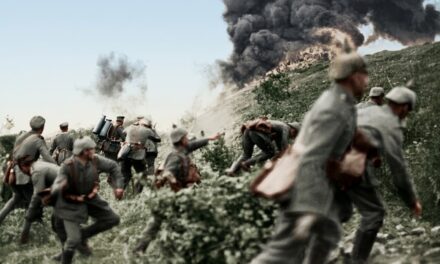
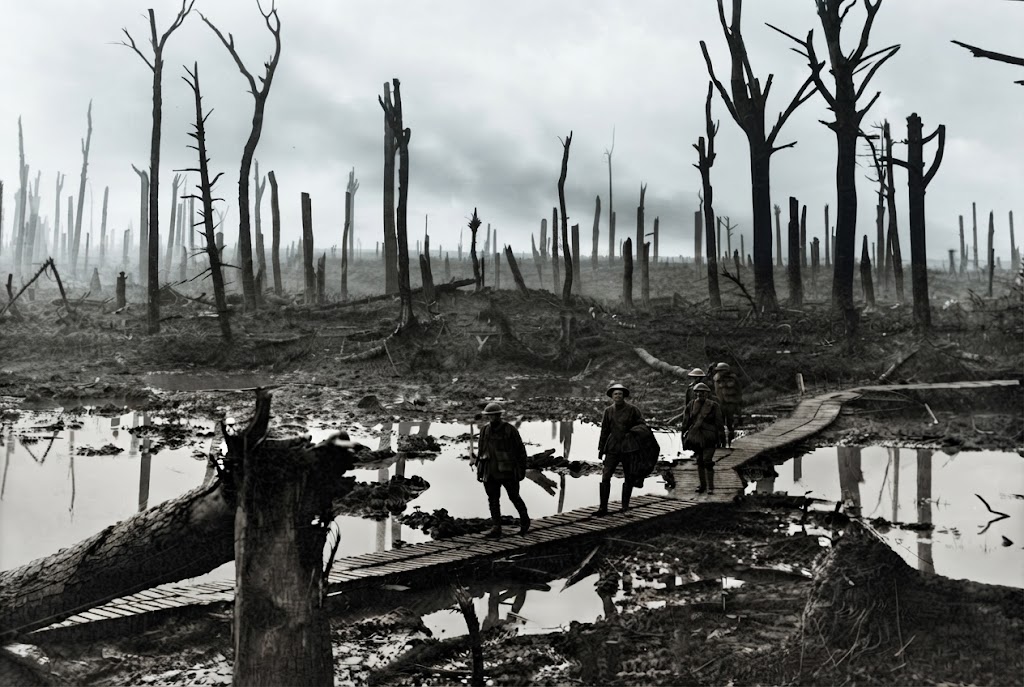
The offensive that would become known as the Third Battle of Ypres opened on July 31, 1917, with a preliminary bombardment of more than four million shells followed by an infantry assault toward the village of Passchendaele, some five miles beyond the start line. Early gains were modest, and an unusually wet August — among the rainiest recorded in the region in decades — turned the reclaimed Flanders farmland, much of it drained fields whose centuries-old dyke systems had been destroyed by the bombardment, into a swamp that swallowed men, horses, and artillery alike. General Sir Herbert Plumer took over the main thrust in September and shifted to a “bite and hold” method, seizing limited objectives behind concentrated artillery cover and then digging in against the inevitable German counterattack, a change in tactics that produced steadier if still costly gains through the ridges east of Ypres. Fighting ground on in stages through the autumn as British, ANZAC, and Canadian forces inched toward the ridge, with the village of Passchendaele itself not falling until November, months after the offensive had begun.
The Battle of Passchendaele
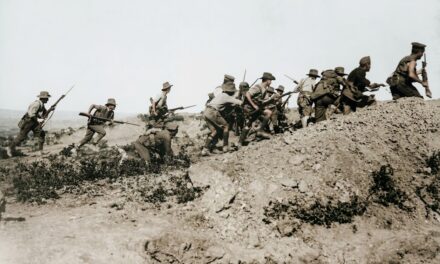
The attack on Bellevue Spur on October 12, 1917 became one of the costliest single actions of the entire battle, as New Zealand and Australian troops advanced across open, waterlogged ground toward German concrete pillboxes whose machine guns had barely been touched by a bombardment softened by rain and mud. Private Leonard Hart of the New Zealand forces, writing to his parents exactly a week later, described men caught on belts of uncut barbed wire and shot down in full view of their surviving comrades, and wounded soldiers left where they fell in the half-frozen mud after officers were forced to call off rescue attempts under fire. New Zealand’s official history would later record the day as the costliest of the country’s entire military history, a single afternoon whose losses have never been matched before or since, with well over a thousand New Zealand casualties recorded in a matter of hours.
The mud itself became as feared as the German guns. Canadian volunteer Fred Albright wrote what would be his last letter to his wife Evelyn on October 19 and 20, describing a bombardment “by far the heaviest I’ve heard yet” and vast numbers of aircraft passing overhead; he was killed in the fighting for Passchendaele village only days later. British officer Edwin Campion Vaughan, a second lieutenant with the Royal Warwickshire Regiment, kept a diary — published decades afterward as Some Desperate Glory — recording the near-total destruction of his company in the swamp around the ridge; his entry for August 28 closes with him sitting alone, drinking whisky, staring into what he called “a black and empty future.”
War correspondent Sir Philip Gibbs, one of only five official British journalists accredited to the Western Front, covered the offensive for the British press and later expanded his dispatches into the book From Bapaume to Passchendaele, 1917, offering one of the more candid wartime accounts of the fighting’s toll within the limits of official censorship. The Canadian Corps, brought in for the final push after months of British, ANZAC, and other Commonwealth divisions had already been ground down on the ridge, took the ruins of Passchendaele village on November 6, 1917, effectively ending the offensive at a cost of some sixteen thousand further Canadian casualties alone. The battle had advanced the British line roughly five miles at a combined cost, across both sides, estimated at several hundred thousand casualties, a toll historians have debated ever since given how little the ground gained changed the wider strategic situation on the Western Front, and one that has made Passchendaele a recurring case study in military academies examining the limits of attrition as a strategy. The scale of the losses, set against that modest advance, made Passchendaele a byword within a generation for the futility of attritional warfare.
The Legacy of Passchendaele
Passchendaele has endured as shorthand for the horror of industrialized warfare at its most futile — a battle in which roughly five miles of shattered ground cost both sides a combined toll estimated at several hundred thousand casualties, without materially altering the course of the war. Much of the ground taken at such expense in the autumn of 1917 was voluntarily abandoned by British forces only months later, during the German spring offensive of 1918, deepening the postwar sense that the battle’s gains had been illusory. It hardened British and Commonwealth memory of the First World War around images of mud, wire, and slaughter that later poets, memoirists, and historians would return to again and again as the emblem of the war’s cost. Ground taken at such expense and given up so soon after is a hard thing for any army to make peace with, and Passchendaele has never entirely stopped standing for that particular kind of loss — a name invoked whenever a plan’s cost has quietly outgrown whatever it was meant to achieve.
Visiting Tyne Cot Today
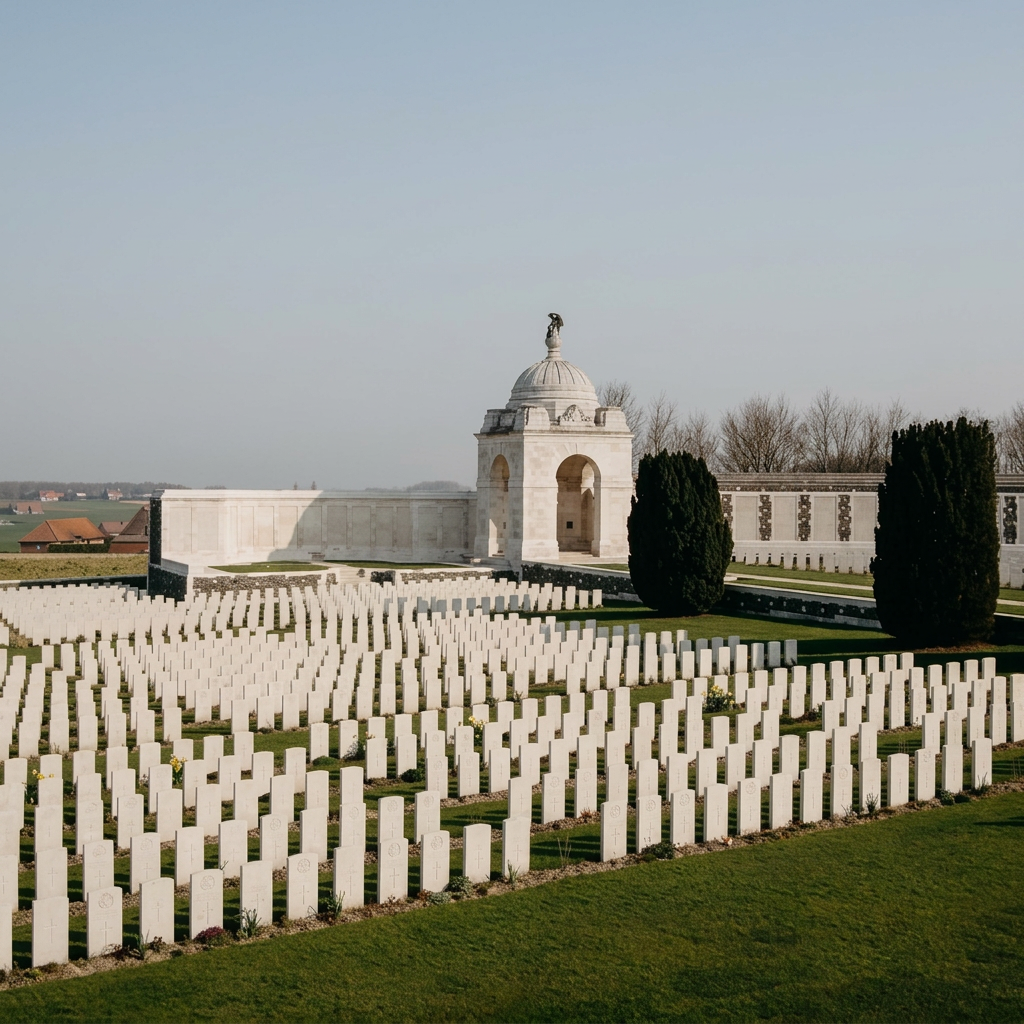
Today the ground around Passchendaele is anchored by Tyne Cot Cemetery, the largest Commonwealth War Graves Commission cemetery in the world, holding just under 12,000 burials beneath a broad semicircular memorial wall that additionally names tens of thousands of soldiers whose remains were never recovered or identified. The cemetery sits on the former battlefield itself, built around a cluster of German pillboxes that once anchored this stretch of the ridge — one still stands incorporated into the cemetery’s central Cross of Sacrifice, a rare instance of a wartime structure left in place rather than cleared. A visitor centre near the entrance provides historical context and personal stories tied to individual graves, drawing on Commonwealth War Graves Commission records to help visitors trace individual soldiers among the rows, and the grounds are open and free to enter daily year-round.
Tyne Cot sits near the town of Zonnebeke, about nine kilometers northeast of Ypres, and both the cemetery and its visitor centre are open daily without charge. Spring through autumn is the most comfortable season to visit, since much of the surrounding Ypres Salient remains working farmland with uneven paths that can be difficult after rain, and the flat, low-lying terrain that made the 1917 fighting so treacherous is still evident to anyone walking the site today. The site offers wheelchair access through a signposted rear entrance, and no advance booking is required for a general visit, though the visitor centre can help arrange a guided tour for those who want deeper context than the headstones and memorial wall provide on their own.
Remembrance at Tyne Cot
Every evening at eight o’clock, the Last Post is sounded beneath the Menin Gate in nearby Ypres, a ceremony held nightly without charge since 1928 and paused only during the German occupation of 1940 to 1944, when it continued instead at Brookwood Military Cemetery in England until Ypres was liberated, resuming beneath the Gate itself the very evening the town was freed. The ritual honors the tens of thousands of Commonwealth soldiers killed in the Ypres Salient whose bodies were never found, many of them from the fighting around Passchendaele itself, and buglers from the local fire brigade have carried on the tradition for close to a century. At Tyne Cot, remembrance is less a single annual event than a constant presence: the sheer scale of the cemetery, and the wall of names surrounding it, keeps the memory of the battle in front of every visitor who walks its rows, while wreaths and personal tributes accumulate at the memorial through the year rather than only on a fixed anniversary. School groups from Britain, Canada, New Zealand, and Australia make up a steady share of visitors throughout the year, often tracing a specific name from the memorial wall back to a family connection generations removed from the fighting itself.
Visitor Info: www.cwgc.org — official Commonwealth War Graves Commission page for Tyne Cot Cemetery, the principal WWI cemetery associated with the Passchendaele battlefield.
Location: Tyne Cot Cemetery, Tynecotstraat, 8980 Zonnebeke, Belgium
Site Status: National Park / Managed Historic Site
Visitation Notes: Tyne Cot Cemetery sits near Zonnebeke, about 9 km northeast of Ieper (Ypres); the site and its visitor centre are open daily and free to enter. Spring through autumn is the most comfortable season, since the surrounding Salient is still farmland with uneven paths. Every evening at 8pm the Last Post is sounded beneath Ypres’ Menin Gate, a ceremony run nightly since 1928 (paused only during the German occupation of 1940-44) in memory of the Ypres Salient’s missing. No booking is required for either site, and Tyne Cot offers wheelchair access via a signposted rear entrance.
Google Map
Firsthand Accounts
One visitor was struck by the staggering scale of the cemetery, noting it isn’t just the number of graves but how many belong to soldiers who were never identified.
— from Google Reviews
Christine E described attending the Last Post ceremony after touring a WWI museum, finding it deeply emotional as the bugle played and even the birds seemed to fall silent, with a young Australian boy honoring a fallen ancestor by reading a family message.
— from TripAdvisor
A Lonely Planet guide entry calls Tyne Cot probably the most-visited site in the Ypres Salient, describing it as the world’s biggest British Commonwealth war cemetery with nearly 12,000 graves beneath a huge semicircular memorial wall.
— from Lonely Planet
Erik W said what struck them most at Tyne Cot was how young the fallen were, noting the oldest they saw recorded was 30 but most were only 22 or 23.
— from Google Reviews