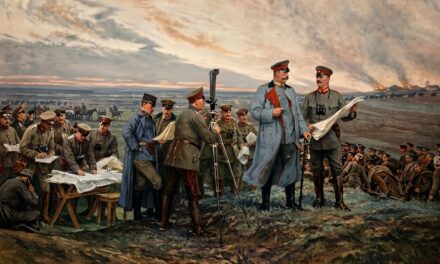
In a memorandum he claimed to have written before the guns ever fired, Germany’s chief of staff described a target that had nothing to do with capturing ground. France, he argued, would defend Verdun to the last man rather than surrender it, which meant the German army did not need to break through at all — it only needed to keep killing French soldiers faster than France could replace them, for as long as it took to bleed the country white.
Verdun: The Road to Battle
By the winter of 1915, the Western Front had settled into a stalemate that neither side’s generals could see a clean way through, with both armies dug into trench lines that had barely moved in over a year despite enormous offensives on the Marne, in Artois, and in Champagne. Erich von Falkenhayn, chief of the German general staff, concluded that Germany couldn’t win the war by breaking the Allied line outright, but might win it by breaking France’s will to keep fighting, and he chose Verdun as the place to try. The city held enormous symbolic weight in French memory as a fortress that had never fallen, ringed by a belt of forts built up over decades to guard the approach to Paris, which made it a target the French high command would feel bound to defend regardless of the human cost — precisely the calculation Falkenhayn was counting on.
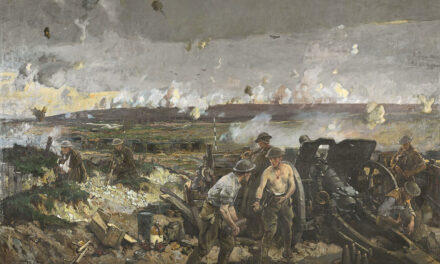
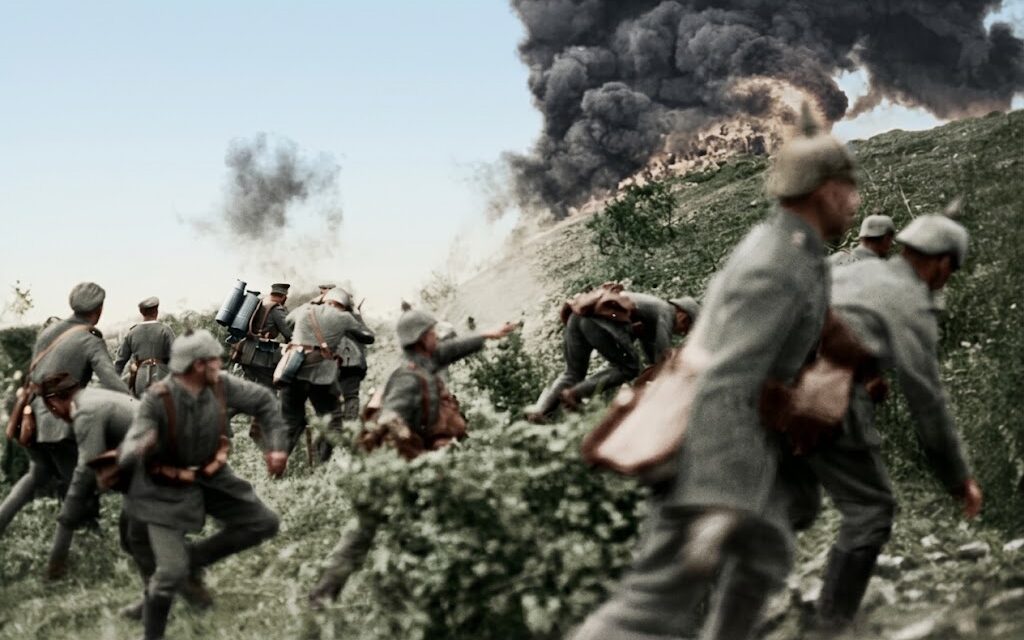
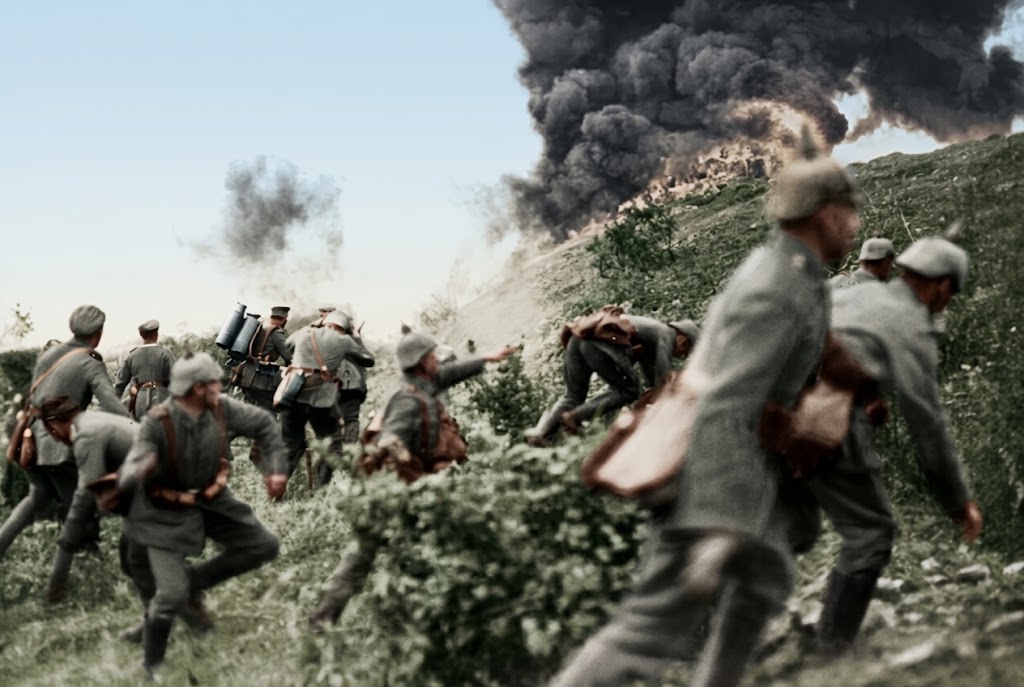
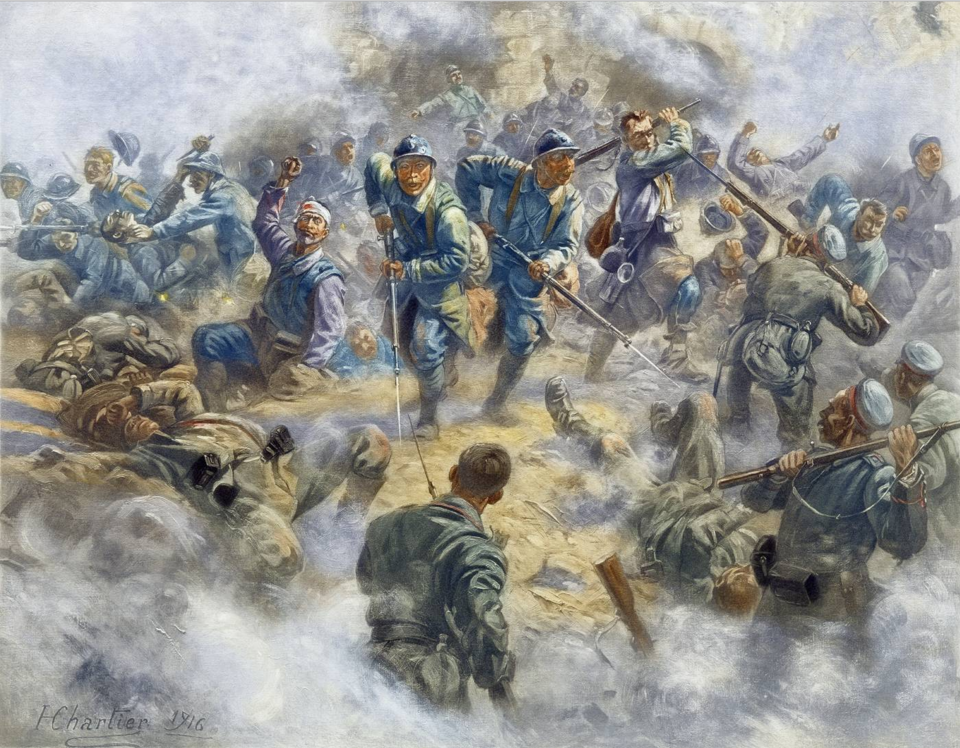
Falkenhayn massed roughly 1,200 guns opposite a sector defended by a comparatively thin French garrison, a deliberate imbalance meant to guarantee that whatever ground German infantry took would cost French lives out of all proportion to what it cost to hold. On February 21, 1916, he opened the battle with one of the heaviest artillery bombardments the war had yet seen, a shattering nine-hour barrage aimed at collapsing the French defense before the infantry ever advanced, followed by German storm troops probing forward behind a curtain of shellfire the likes of which most defenders had never experienced. Among the defenders was Lieutenant-Colonel Émile Driant, who had publicly warned before the attack, in terms sharp enough to reach the French parliament, that Verdun’s defenses were dangerously under-manned; he was killed that first day holding the Bois des Caures with two battalions of French chasseurs, a death that seemed to confirm every warning he had made and that quickly became one of the battle’s first widely reported losses.
The Battle of Verdun
The German advance in the opening days was fast enough to shock the French command, culminating on February 25 in the near-unopposed capture of Fort Douaumont, the largest and most modern fort in the Verdun ring, seized by a small German raiding party who found it thinly garrisoned and its heavy guns already removed for use elsewhere on the front in the mistaken belief that fixed fortifications no longer mattered against modern artillery. The loss of Douaumont, more than any battlefield reversal, galvanized the French response and became a national scandal in its own right, and General Philippe Pétain was given command of the sector with orders to hold it at any cost regardless of what it demanded of the men under him.
Pétain’s most consequential decision wasn’t tactical but logistical: recognizing that the single road running south from Bar-le-Duc was Verdun’s only reliable supply line once the railway into the city came under German artillery range, he organized it into a continuously running convoy route, later nicknamed the Voie Sacrée, with thousands of trucks running around the clock to keep men, ammunition, and food moving forward. He also rotated French divisions through the sector on a fixed schedule so that no unit endured the fighting indefinitely without relief, a system known as the noria after the chain-bucket water wheels it resembled. Over the course of the battle, a majority of the entire French army would cycle through Verdun under this system, which spread the losses across the force but also meant an extraordinary proportion of French soldiers came to carry some direct memory of the place, whether or not they fought at its worst moments.
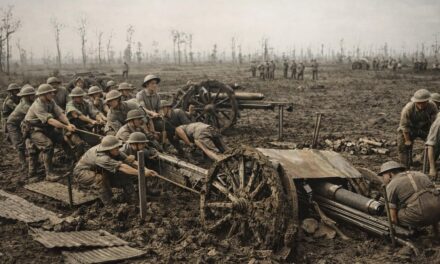
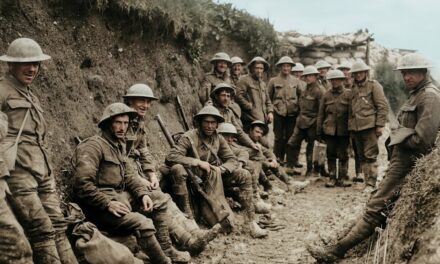
The fighting ground on for months over specific, murderously contested terrain, Fort Vaux, Mort-Homme hill, and Côte 304 among the names that recur throughout the accounts, each fought over repeatedly as ground changed hands in attacks that gained a few hundred meters at a staggering cost in lives. Major Sylvain-Eugène Raynal commanded Fort Vaux’s garrison through a siege from June 2 to June 8, 1916, holding out in darkness and heat after the fort’s water supply failed, its defenders reduced to drinking their own condensation, until his final messages, sent out by carrier pigeon as the last working means of communication, made clear surrender was the only remaining option; he later published his own account of the defense. Captain Charles Delvert, fighting with the 101st Infantry Regiment near Fort Vaux, kept a war diary describing the fighting in granular, unromantic detail, down to the exhaustion and fear of men holding a position under constant shellfire, and Lieutenant Henri Desagneaux recorded similarly firsthand entries on the conditions French infantry endured in the sector, describing scenes of mud, corpses, and shattered ground that left little resembling a battlefield in any conventional sense. By the time French counteroffensives under Generals Nivelle and Mangin recaptured Douaumont and Vaux in the war’s closing months of 1916, the battle had run for roughly ten months and inflicted an estimated 700,000 or more combined casualties, making it one of the longest and costliest single engagements of the entire war and leaving the ground itself so churned and poisoned by shells that parts of it remain officially unfarmable more than a century later.
The Legacy of Verdun
Falkenhayn’s stated aim of bleeding France white succeeded only in the narrowest sense, since the battle bled Germany just as badly and won no ground worth the cost on either side. What Verdun actually produced was a symbol that outlasted the war itself, a French national byword for stubborn endurance under the worst conditions the front could offer, and today one of the war’s clearest monuments to the fact that industrial-scale attrition has no real winner, only two exhausted armies and a landscape neither side ever fully controlled.
Visiting Verdun Today
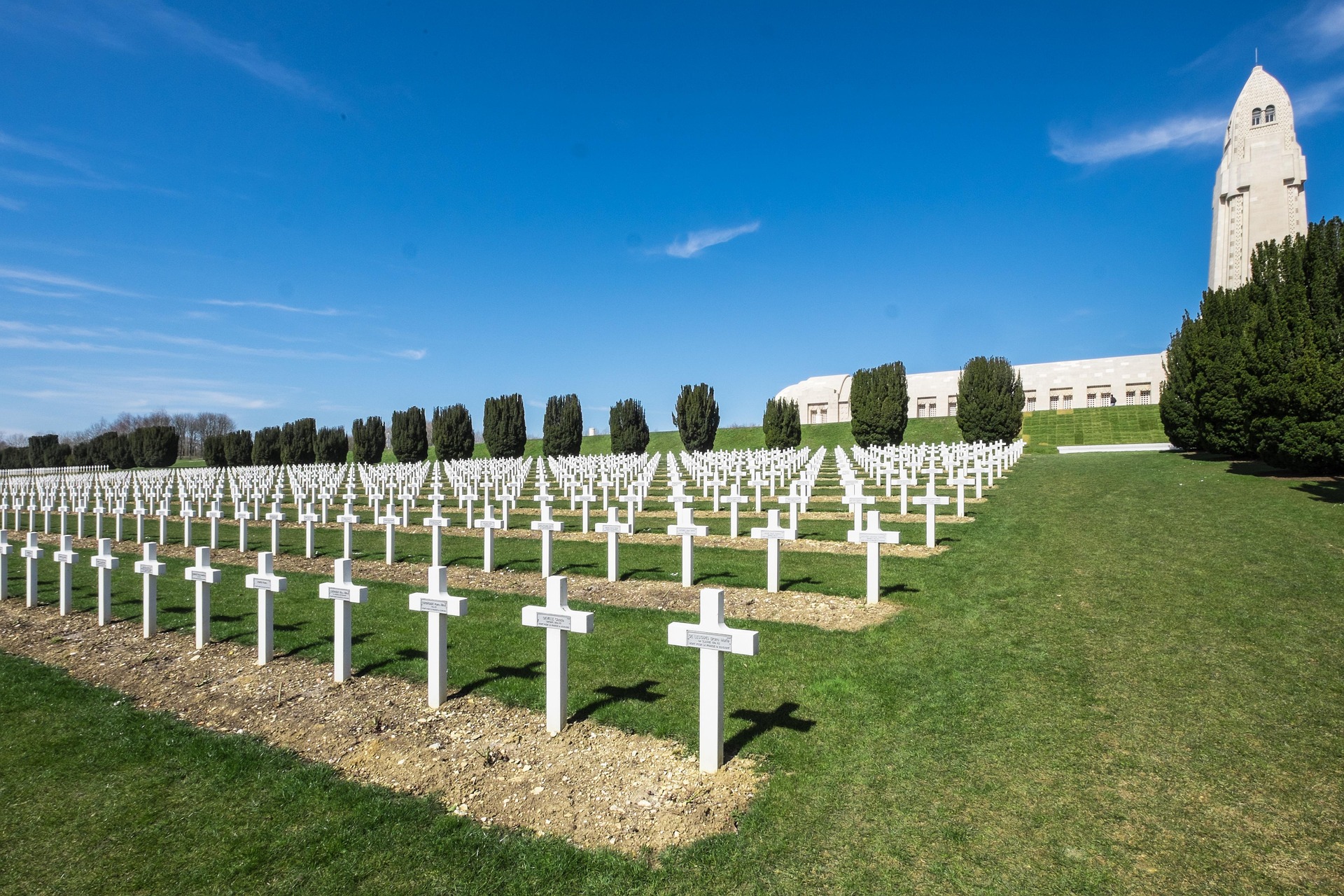
The Verdun battlefield memorial zone sits just outside the town of Verdun in France’s Meuse department, anchored by the Douaumont Ossuary and the Mémorial de Verdun museum, with Fort Douaumont and Fort Vaux both preserved nearby. The site is open year-round, with longer hours in the spring-to-autumn season, and a modest entrance fee applies to the Ossuary and Memorial; booking ahead is recommended during peak season, though not strictly required. Visitors should note that the Mémorial de Verdun is only partially accessible for those with mobility needs, and that the underground fort passages involve stairs and uneven ground.
A visit typically combines the Mémorial de Verdun’s exhibits with the physical experience of the forts themselves, and the ground surrounding Douaumont and Vaux still bears the cratered, pockmarked texture left by a bombardment that reshaped the terrain a century ago. Between the museum, the ossuary, and the two forts, a full visit is easily an afternoon’s worth of walking, and the site rewards visitors willing to move between its indoor exhibits and its outdoor ground rather than treating either half as sufficient on its own.
Remembrance at Verdun
Verdun holds joint French-German remembrance ceremonies each year around the anniversary of the battle, a deliberate choice given how thoroughly the fighting devastated both nations’ armies rather than just one. That shared mourning has become part of the site’s identity in a way few other WWI battlefields can claim, reflecting a reconciliation between the two countries that took decades to build after 1916 and that the annual ceremony now formally embodies. For French visitors especially, the Ossuary continues to function as a working site of personal memory, a place where descendants still come to mark relatives who fought there a century ago rather than a purely historical stop on a tour.
Visitor Info: Official website titled “Mémorial de Verdun” (Mémorial de Verdun museum)
Location: Fleury-devant-Douaumont, near Verdun, Meuse, Grand Est, France (Douaumont Ossuary / Mémorial de Verdun museum area)
Site Status: National Park / Managed Historic Site
Visitation Notes: The Verdun battlefield memorial zone sits just outside the town of Verdun, in France’s Meuse department, and is anchored by the Douaumont Ossuary and the Mémorial de Verdun museum, with Fort Douaumont and Fort Vaux nearby. The site is open year-round, though hours run longer in the spring-to-autumn season; admission to the Ossuary and Memorial carries a modest entrance fee, and advance booking is recommended in peak season though not strictly required. The Mémorial de Verdun notes it is only partially accessible for visitors with mobility needs, and the underground fort passages involve stairs and uneven ground. The site hosts French-German remembrance ceremonies around the anniversary of the battle each year.
Google Map
Visitor Comments
chachalat praised the Douaumont Ossuary’s introductory film and the warmth of on-site staff, describing the climb up the memorial tower as emotionally powerful, and noted the site’s continued use as a place of quiet gathering and remembrance.
— from TripAdvisor
O R found the roughly 20-minute introductory film well-made and the tower climb worthwhile, and noted that visitors can only view the ossuary’s piled remains through small exterior windows rather than entering the building itself.
— from TripAdvisor
The reviewer described the Mémorial de Verdun museum as artifact-rich with strong English-language interpretation, and Fort Douaumont as a walk through nearly two miles of cold, damp underground corridors via audioguide, ending in a climb to the shelled fort roof where French, German, and European flags now fly together.
— from Rick Steves’ Travel Blog
717717 described lighting a candle at the Ossuary in memory of a grandfather who had lost a hand and an eye in the war, illustrating the site’s continuing role as a place of personal and family remembrance rather than pure tourism.
— from TripAdvisor