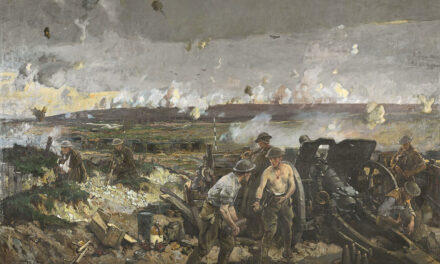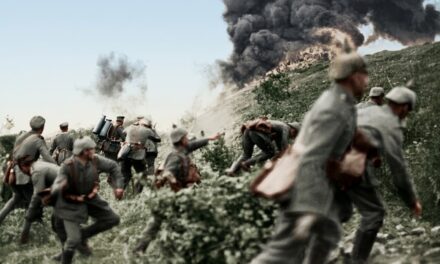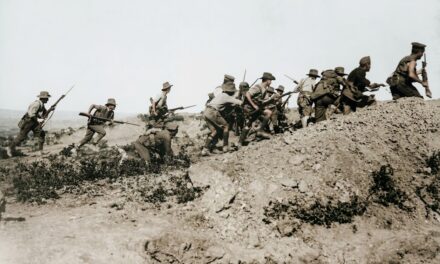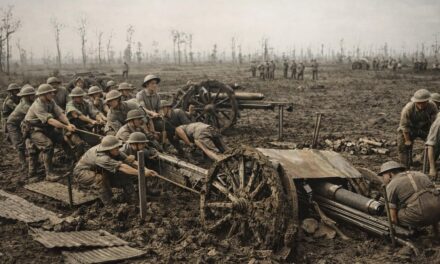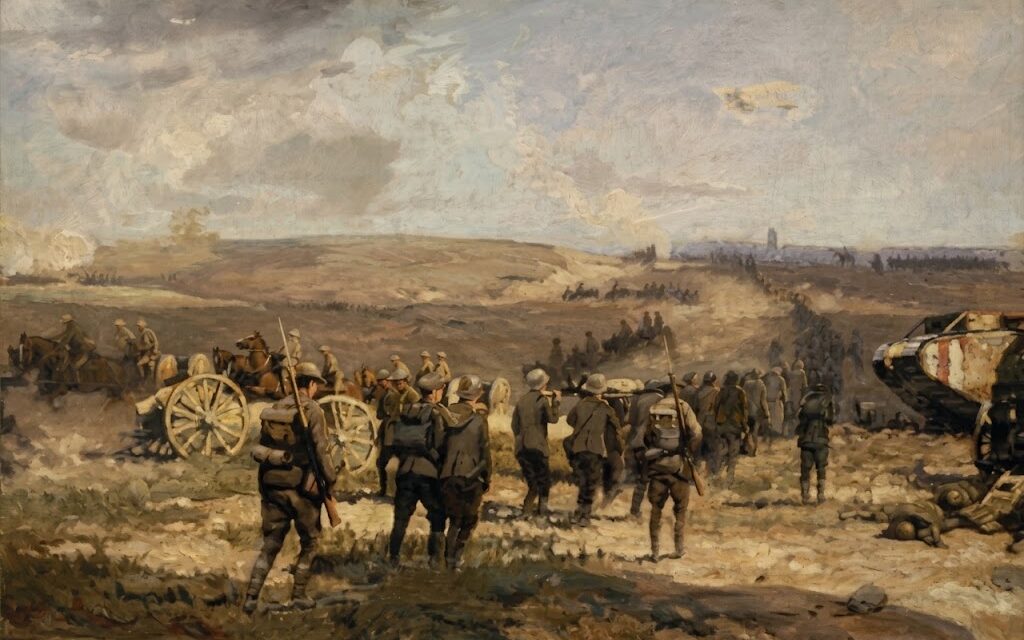
For weeks beforehand, Allied commanders went to extraordinary lengths to make sure the Germans never saw it coming. Tanks moved only at night with their engines masked by low-flying aircraft, canvas covered artillery pieces on the march, wireless traffic that would normally betray a buildup went silent, and a feint attack was staged far to the north to convince German intelligence that any coming offensive would land elsewhere entirely. When more than 500 tanks and thousands of Allied infantry attacked out of thick fog east of Amiens at dawn on August 8, 1918, German defenders were caught completely by surprise, and by nightfall the German First Quartermaster-General, Erich Ludendorff, would call it the blackest day the German Army had suffered in the entire war.
Amiens: The Road to Battle
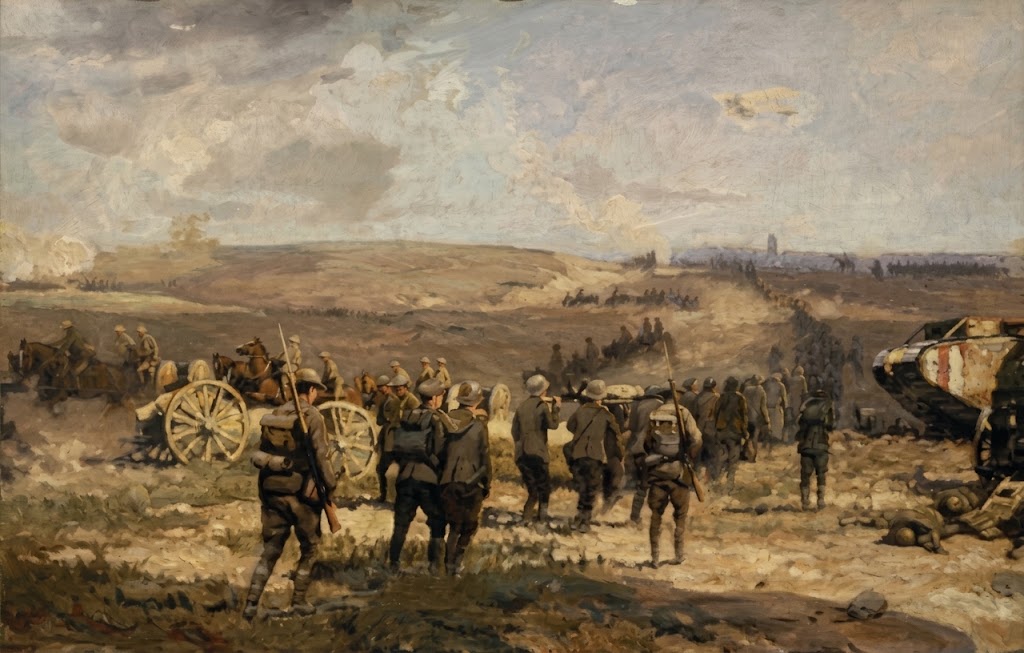
By the summer of 1918, Germany’s massive spring offensives, launched earlier that year in a final attempt to win the war before American troops could arrive in overwhelming numbers, had run out of momentum, leaving exhausted German forces holding an extended and vulnerable line east of the vital rail junction and supply city of Amiens in northern France. Allied commanders recognized the opportunity this presented and began planning a major counteroffensive in strict secrecy, aware that the element of surprise, so rarely achieved after years of static trench warfare on the Western Front, could prove decisive if properly protected. General Sir Henry Rawlinson’s British Fourth Army, which included the Australian Corps under Lieutenant-General Sir John Monash and the Canadian Corps under Lieutenant-General Sir Arthur Currie, was selected to lead the assault alongside the French First Army to the south, with Monash in particular playing a central role in coordinating the detailed combined-arms plan that would follow. Rather than the extended preliminary bombardment that had traditionally announced Allied offensives and given German defenders days of warning to reinforce threatened sectors, planners built a strategy around achieving total tactical surprise, moving hundreds of tanks and additional divisions into position under cover of darkness and enforcing strict secrecy measures across the entire staging area in the days leading up to the attack. A deliberate decoy operation was even staged well to the north, near Kemmel, designed to draw German attention away from the true staging area and reinforce the impression that any coming Allied offensive would fall elsewhere along the front entirely. By the first week of August, more than 500 tanks, thousands of artillery pieces, and several hundred aircraft stood ready behind the front line, poised for an assault timed to begin in the pre-dawn fog that regularly settled over the river valleys east of Amiens at that time of year, with commanders betting that the combination of surprise, fog, and overwhelming combined-arms force would achieve in hours what earlier offensives had failed to achieve across weeks of costly fighting.
The Battle of Amiens
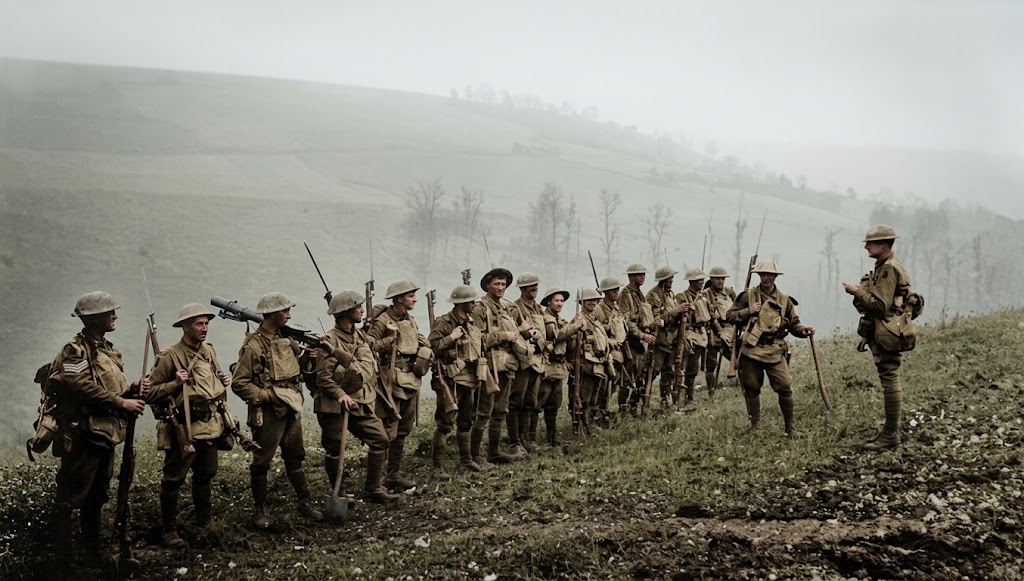
The attack began at 4:20 on the morning of August 8, 1918, as Allied artillery opened without any preceding bombardment to warn the Germans, and tanks and infantry advanced together through heavy fog that concealed their movement even as it complicated coordination among the advancing units themselves. German defenders, taken almost completely by surprise and lacking the deep, heavily fortified positions that had characterized earlier stages of the war, were overwhelmed in sector after sector as Australian and Canadian troops in particular drove deep into German-held territory behind a closely coordinated screen of tanks, aircraft, and artillery, with the Canadian Corps under Lieutenant-General Currie and the Australian Corps under Monash advancing side by side across the southern portion of the assault front while British divisions pressed forward to the north. By the end of the first day, Allied forces had advanced as much as eight miles in places, an extraordinary distance by the standards of a war in which previous offensives had often measured gains in mere hundreds of yards at enormous cost, and German losses on that single day alone reached roughly 30,000 men, including some 12,000 taken prisoner, alongside the loss of hundreds of artillery pieces overrun in the rapid advance before their crews could withdraw them. Allied casualties for the day, while still substantial at several thousand, were markedly lower than losses typically suffered in previous Western Front offensives of comparable scale, a reflection of how effectively the combination of surprise, tanks, and coordinated artillery had reduced the exposure of advancing infantry compared to the unsupported frontal assaults of earlier years. Fighting continued over the following days as the offensive pushed further east, though the pace of advance slowed considerably after the first day’s dramatic gains as German reserves arrived and resistance stiffened, with the main phase of the battle generally considered to have concluded around August 12 as Allied commanders paused to consolidate their gains and address the logistical strain of such a rapid advance, including the difficulty of keeping supply lines and reserve tank units moving fast enough to support infantry that had outrun much of its original planning. Reports reaching German headquarters described entire units surrendering to small numbers of advancing Allied soldiers and officers struggling to rally troops who had lost confidence that the war could still be won, a collapse in morale that alarmed the German high command far more than the territorial losses themselves. When Ludendorff learned the scale of the defeat, he later wrote that August 8 was the blackest day of the German Army in the history of the war, a judgment that reflected not the battle’s casualty figures alone but the psychological blow of watching a supposedly unbreakable defensive line collapse in a matter of hours.
The Legacy of Amiens
The Battle of Amiens marked the opening of what became known as the Hundred Days Offensive, a sustained series of Allied attacks that pushed German forces steadily backward along the length of the Western Front through the late summer and autumn of 1918 without allowing them the extended pause needed to rebuild a stable defensive line. The battle’s combined-arms approach, coordinating tanks, aircraft, artillery, and infantry in a single closely timed assault rather than relying on infantry and artillery alone, influenced military thinking about mobile warfare for decades afterward and is often cited as a preview of tactics that would be further developed in later conflicts. Convinced after Amiens that the war could no longer be won militarily, Ludendorff pressed German political leaders toward seeking an armistice, a process that culminated in Germany’s surrender roughly three months later, on November 11, 1918.
What Remains at Amiens
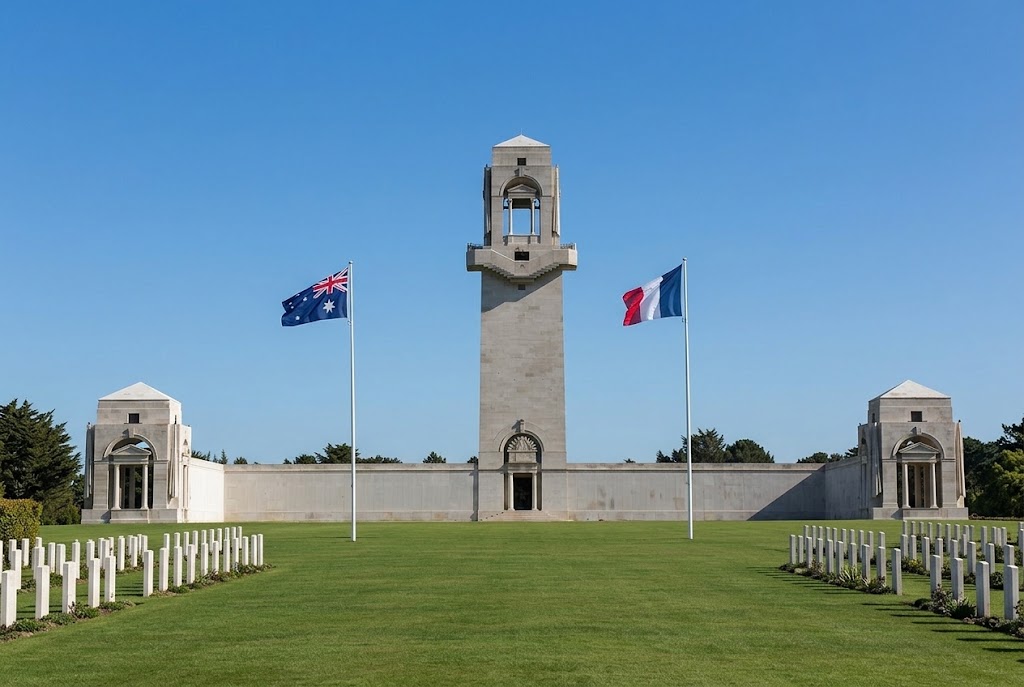
Unlike some other major First World War battles, Amiens was fought across a wide, diffuse stretch of open countryside that has since returned to ordinary farmland, leaving no single preserved battlefield site for visitors to walk in the way some other Western Front battles offer. The primary site connected directly to the battle today is the Sir John Monash Centre, located on Hill 104 near Villers-Bretonneux, adjacent to the Australian National Memorial and its accompanying war cemetery, and free to visit for anyone interested in the battle’s history. The centre uses an immersive multimedia approach to tell the story of Australia’s role in the war’s final year, and visitors are generally advised to allow several hours to experience its full exhibits properly rather than treating it as a brief stop, with advance booking recommended around commemorative periods such as Anzac Day when demand for tours rises sharply. The nearby Franco-Australian Museum in the center of Villers-Bretonneux, along with scattered village and unit memorials distributed across the wider area where the battle was fought, round out the picture for visitors willing to travel a bit further afield. Spring and summer tend to be the busiest seasons for visitors to the region, and arriving early in the day generally means smaller crowds at the Monash Centre’s exhibits and a quieter visit to the adjoining cemetery grounds. Because the battle unfolded across such a broad and largely unmarked stretch of countryside, visitors hoping to trace the day’s advance in detail are generally better served by combining a visit to the Monash Centre with the wider network of village memorials than by expecting a single walkable battlefield comparable to some of the more concentrated Western Front sites elsewhere in the region.
Remembrance at Amiens
Lieutenant-General Sir John Monash, who commanded the Australian Corps during the assault, described the battle’s planning and execution in his postwar book The Australian Victories in France in 1918, published in 1920, including the exhortation he delivered to his troops beforehand calling the coming operation one of the most important of the entire war, a firsthand commander’s account grounded in his direct role shaping the attack. From the opposite side of the front line, Erich Ludendorff’s postwar memoir, My War Memories, 1914-1918, published in English translation in 1919, offers the best-documented German perspective on the defeat, describing how news of the collapse reached headquarters and troops surrendering to individual enemy soldiers, alongside his now-famous verdict that August 8 stood as the blackest day the German Army suffered in the entire war. Read together, Monash’s confident planning account and Ludendorff’s shaken reckoning with defeat preserve the battle from the perspectives of the general who engineered the surprise and the opposing commander who absorbed its full psychological weight, an unusually direct pairing of triumph and collapse recorded by the two men who understood the battle’s stakes better than almost anyone else on either side. Ordinary soldiers left their own record of the fighting as well, including the 1918 diary of Driver John Henry Llewellyn Turnbull of the 5th Divisional Ammunition Column, held today by the Australian War Memorial, which documents the Amiens, Albert, and Bapaume fighting in granular day-to-day detail, and the wartime diary of Lieutenant-Colonel Thomas-Louis Tremblay, commander of the 22nd Battalion, describing the Canadian Corps’ opening barrage and advance on the morning of August 8 from an officer’s vantage point within the attacking force itself.
Visitor Info: Book titled “Amiens 1918: The Last Great Battle” by James McWilliams and R. James Steel (Spellmount/History Press, 2001)
Location: Sir John Monash Centre, Villers-Bretonneux, Somme, France
Site Status: Marker or Monument Only
Visitation Notes: Unlike some earlier WWI battles, Amiens was fought across a wide, diffuse swath of open countryside now returned to farmland, so there is no single preserved battlefield — the Sir John Monash Centre on Hill 104 near Villers-Bretonneux, adjacent to the Australian National Memorial and war cemetery, is the primary site tied directly to this battle and free to visit. Allow several hours for the full multimedia experience, and book ahead around commemorative periods such as Anzac Day. The Franco-Australian Museum in the town center and scattered village and unit memorials across the former battle area round out the picture. Spring through summer tends to be busiest; early mornings are quieter.
Google Map
Visitor Comments
This is a magnificent, state-of-the-art visitors centre, with app-driven multimedia displays and production quality far beyond what you’d expect for a small rural site comments Stay28500649747. Walking back through the adjacent military cemetery afterward really drives the history home.
— from TripAdvisor
If you’re traveling to France and planning to visit the WWI battlefields, Richard T says to make sure the Sir John Monash Centre is on your list — it’s an essential stop for understanding the Australian role in the war’s final year.
— from TripAdvisor
“If I could give it ten stars, I would” remarked Rachel T — “the staff go far above and beyond to make sure visitors understand and feel the significance of what happened here.”
— from TripAdvisor
According to Jessy L, the centre does a wonderful job connecting with younger generations, helping them understand the sacrifices made by Australian soldiers in France in a way that feels genuinely engaging rather than dry.
— from Wanderlog