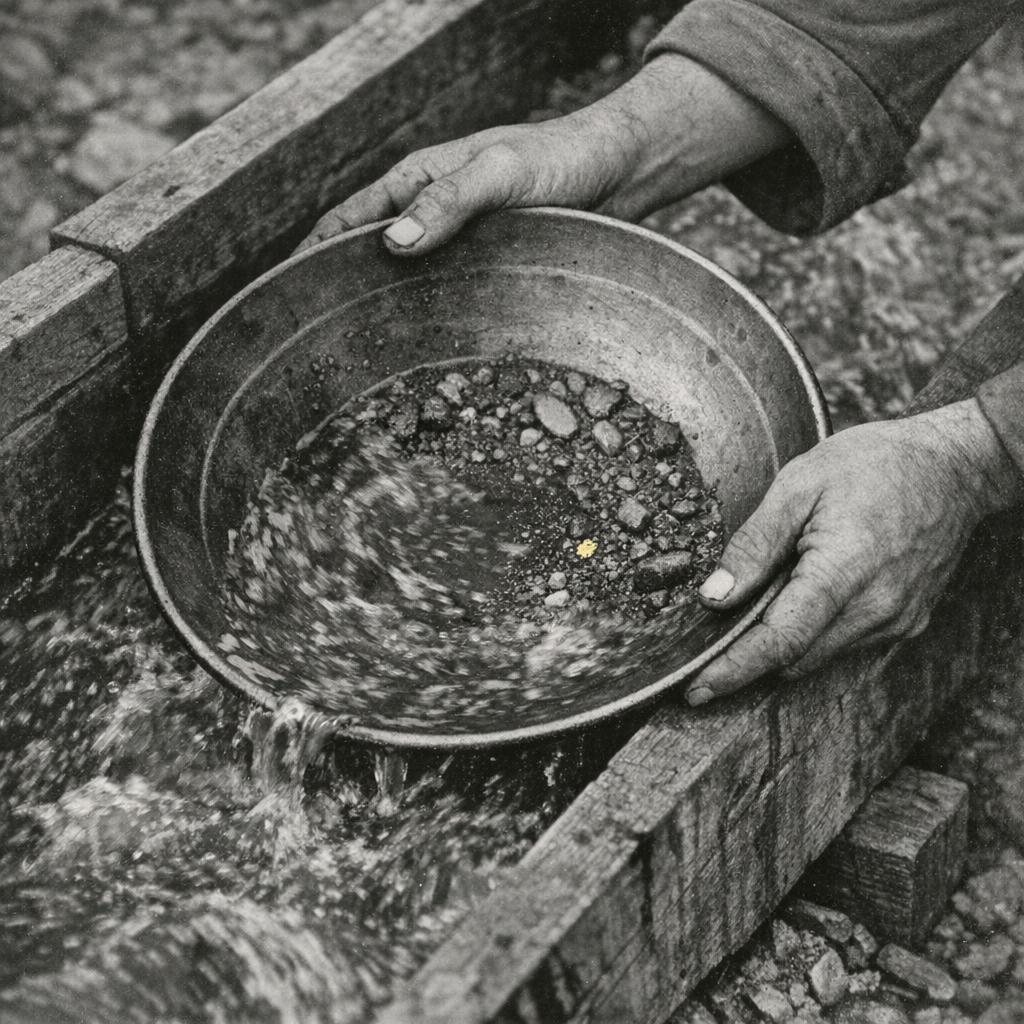
Water swirls in a shallow steel pan, mud and gravel spinning in slow circles while a pair of hands tilts it back and forth, letting the lighter material wash over the lip. Somewhere near the bottom, catching the afternoon light for just a second, a fleck of color holds still against the black sand while everything else keeps moving. It’s small. It’s also real gold, panned out of a trough behind a wooden storefront on a street built for exactly this purpose.

Columbia State Historic Park: California’s Living Gold Rush Town
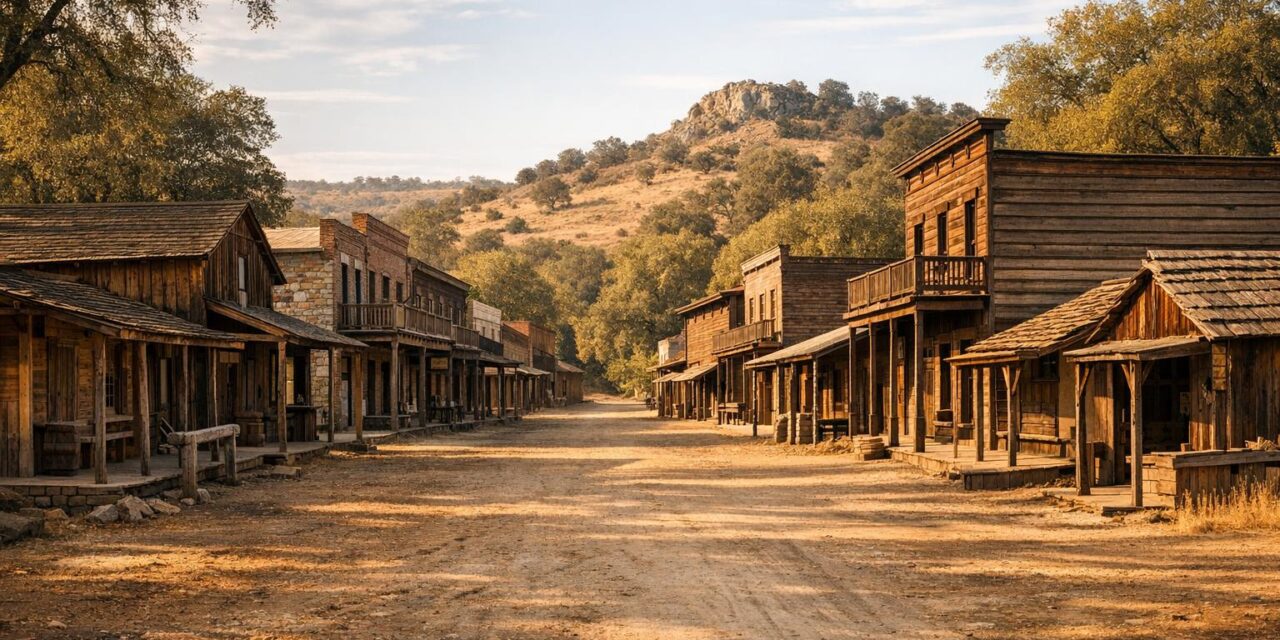
Columbia State Historic Park sits in Columbia, California, a town that traces directly back to the 1850s California Gold Rush boomtown that once occupied this same ground. What sets Columbia apart from so many of the era’s other boomtowns is right there in how the park describes itself: a living Gold Rush town, not a ruin, not a scattering of collapsed foundations left to the weather. Where plenty of nineteenth-century mining camps across California and Nevada and the broader West eventually emptied out entirely, their buildings left to fall in on themselves once the gold ran thin, Columbia took a different path. The state stepped in, preserved the townsite, and kept it operating as an actual functioning place rather than an archaeological site behind a fence.
That distinction matters more than it might first appear. A ghost town preserves absence: it shows visitors what was left behind when people walked away. A living historic town preserves continuity instead, keeping storefronts, streets, and the basic rhythm of a nineteenth-century mining community intact and active rather than frozen at the moment of abandonment. Columbia’s identity as a State Historic Park reflects that choice directly. Today the park exists specifically to give visitors a genuine sense of what an 1850s Gold Rush boomtown looked and felt like, not through static displays behind glass but through a town that still, in its own managed way, functions.
Central to that living identity is something most historic sites can’t offer at all: the chance to actually pan for real gold, on-site, using the same basic method the town’s original prospectors relied on. That’s not incidental to Columbia’s character, it’s arguably the core of it. A visitor doesn’t just walk through a preserved Gold Rush town, they can put their hands in the water and search for the same mineral that built the place in the first place, connecting the historical experience to something tactile and immediate rather than purely observational.
That combination, a preserved townsite plus an active connection to the activity that created it, is genuinely rare among historic sites of any kind, not just Gold Rush towns specifically. Most historic preservation efforts are necessarily hands-off: visitors look, they read placards, they imagine. Columbia’s decision to keep gold panning alive as part of the visitor experience closes that gap in a way few preserved sites manage, turning a walk through history into something closer to a continuation of it.
Preserving a Boomtown Through Concession-Based Panning
The story of how Columbia stayed a living town rather than becoming a ruin is really the story of a deliberate choice: California designated the site a State Historic Park, and in doing so committed to protecting its historic resources rather than leaving the area open to unrestricted digging. That protection shapes everything about how gold panning happens here today, and it’s worth understanding exactly how, because it differs meaningfully from how gold prospecting typically works elsewhere in California.
On most public land in California, gold prospecting generally falls under a fairly permissive default: BLM and U.S. Forest Service land is broadly open to recreational panning and small-scale prospecting without requiring a specific site-by-site permit. Columbia does not follow that default. Because it’s a State Historic Park rather than open BLM or Forest Service land, that generally-open baseline doesn’t directly apply here. Instead, gold panning at Columbia is officially sanctioned, but channeled specifically through Matelot Gulch Mining Company, the park’s designated concessionaire. That’s a deliberate structure, not an oversight or a loophole. It means a visitor’s access to gold panning at Columbia isn’t a matter of showing up with whatever gear they own and starting to dig wherever looks promising; it’s a formal, managed activity run through a specific business operating under the park’s authority.
The rules that come with that structure are specific and worth naming plainly. Panning is restricted to hands and pans only. No other mining equipment, sluice boxes, motorized equipment, metal detectors, anything beyond the basic pan itself, is allowed anywhere in the park. That restriction exists for a clear reason: protecting the historic resources that make Columbia worth visiting in the first place. A park built around preserving an intact nineteenth-century townsite can’t also allow the kind of ground disturbance that heavier prospecting equipment would create. Panning outside the designated concession area, or with unauthorized equipment anywhere on the property, isn’t permitted. That’s a firm boundary, not a suggestion, and it reflects the same underlying logic that keeps Columbia a living town instead of a picked-over dig site: the historic value of the place depends on protecting it, and that protection takes precedence over unrestricted access.
It’s worth sitting with how unusual this arrangement actually is within the broader world of gold prospecting. Most recreational gold panning in California happens on open public land with minimal oversight, a visitor can generally just find a promising stretch of stream and start panning. Columbia inverts that entirely: the panning experience here is curated, concession-run, and geographically confined, precisely because the site around it is historic infrastructure rather than undeveloped wilderness. That’s not a lesser experience, it’s a different one, built around a different set of priorities. A prospector arriving at Columbia expecting the same freedom they’d have on a BLM claim upstream will need to recalibrate, but that recalibration is worth understanding before the visit rather than during it, since the rules here aren’t flexible and aren’t negotiable on-site.
Accessing Columbia State Historic Park Today
Columbia State Historic Park is open to visitors, and gold panning remains an active, sanctioned part of that visit, but only through the specific channel the park has established. Matelot Gulch Mining Company operates as the designated concessionaire, and panning happens through that concession rather than as free-roam prospecting anywhere on the property. A visitor planning to pan for gold here should expect a structured, hands-and-pans-only experience rather than an open search across the townsite.
That restriction to hands and pans alone is worth remembering before a visit: no other mining equipment is permitted anywhere in the park, and panning outside the designated concession area isn’t allowed either. Beyond those specific access rules, Columbia doesn’t carry any elevated hazard beyond what any visitor would expect from normal outdoor and tourist-town activity, meaning this is a genuinely approachable destination for a family or a first-time visitor rather than a site demanding specialized preparation or safety equipment.
The Legacy of Columbia State Historic Park
For anyone serious about the history of gold prospecting, Columbia offers something genuinely distinct: a chance to pan for real gold inside a townsite that isn’t just commemorating the Gold Rush but was actually built by it and has been deliberately kept alive ever since. That’s a different kind of value than an open BLM claim or a private pay-to-dig operation offers. It’s a controlled, historically grounded introduction to the exact method nineteenth-century prospectors used, set inside the preserved town their labor built.
For a hobbyist used to open-range prospecting, the concession model here can take some adjusting to, there’s no wandering off to test a promising bend in a creek, no bringing along a sluice box or a detector to work the ground more aggressively. But that trade-off is the entire point. Columbia is a reminder that this hobby’s history is worth protecting on its own terms, and that a well-managed concession, rather than unrestricted access, is sometimes exactly what keeps a place like this standing, intact and visitable, generations after the gold that built it first drew people here.
Story Source: www.parks.ca.gov
Location: Columbia State Historic Park, Columbia, CA
Site Status: Permission or permit required
Legal Conditions: Tier 2 California override (Verified): Columbia is a California State Historic Park, so the Tier 1 “generally open on BLM/USFS land” default for Gold Prospecting does not directly apply. Gold panning is officially sanctioned but channeled through Matelot Gulch Mining Company, the park’s designated concessionaire, using hands and pans only — no other mining equipment is allowed anywhere in the park, in order to protect historic resources. Panning outside the designated concession area or with unauthorized equipment is not permitted.
Hazards: No elevated hazard beyond normal outdoor/tourist-town activity
Google Map
Firsthand Accounts
On March 27, 1850, prospectors Dr. Thaddeus Hildreth, his brother George Hildreth, and John Walker were caught in a rainstorm near present-day Columbia. While drying out their gear, Walker tried panning the nearby gulch and struck gold; within six weeks the camp, known as “Hildreth’s Diggings,” had drawn thousands of miners.
Miner Leonard W. Gilchrist wrote a firsthand letter from Columbia dated July 2, 1853, to Samuel Mason describing his voyage from New York to California and his work in the gold mines — one of several period letters and diaries from Columbia held in university archival collections documenting daily life during the rush.
A second major fire struck Columbia on August 25, 1857, after grease in a Chinese miner’s cooking pan ignited the canvas wall of his dwelling; the blaze destroyed 13 blocks, including some buildings that had been considered fireproof after the 1854 fire, and the town was rebuilt still more durably afterward.
Local artist Otheto Weston and preservationist Rita Zimmerman formed the Historic Mining Town Preservation League in 1934 specifically to save Columbia from demolition and neglect, laying the groundwork for the state’s eventual purchase of the town roughly a decade later.
On July 15, 1945, California Governor Earl Warren signed SB 1256, creating Columbia State Park after the legislature appropriated $50,000 (to be matched by public funds) to acquire the old business district’s land and buildings — the state later added roughly 235 more acres between 1956 and 1958.