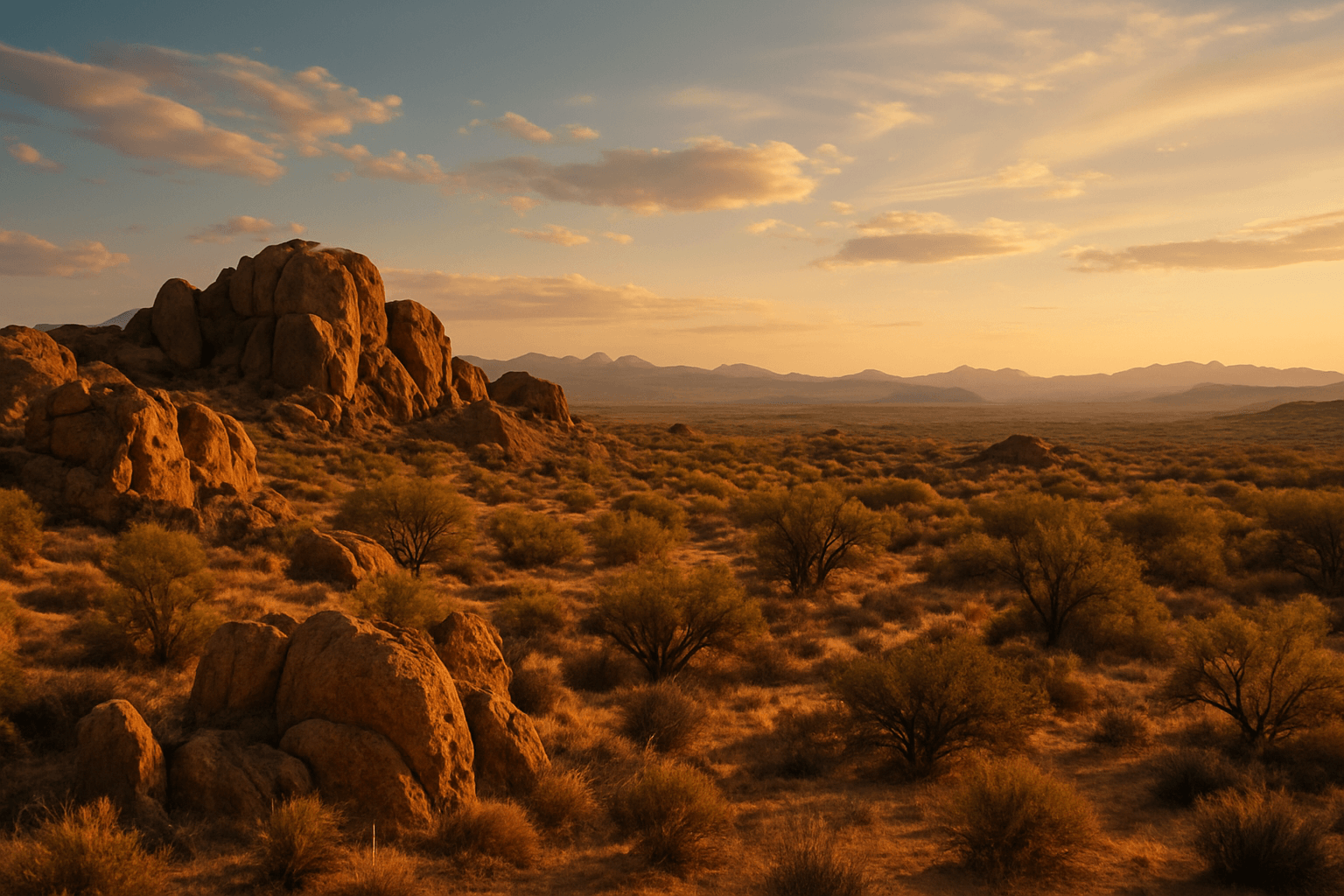
The desert floor here doesn’t look like it’s hiding anything. Weathered granite breaks the surface in low, rust-colored knuckles, sun-bleached and split by centuries of freeze and thaw, and on most mornings the only sound is wind moving through creosote and paloverde. Heat shimmers off bare rock by mid-morning, lizards vanish into shadow between one blink and the next, and the ground gives up nothing at a glance — no glitter, no obvious seam, nothing that looks worth a second look. But bend down at the right outcrop and brush away a little sun-baked gravel, and the ground answers back: a dull, heavy glint that has nothing to do with quartz or mica. It’s gold, sitting loose in weathered rock the way potatoes sit in a garden row, close enough to the surface that a person doesn’t need a shaft or a sluice to find it. Just patience, sharp eyes, and a little luck, in the right square yard of Yavapai County, Arizona — ground that, more than a century and a half ago, earned a nickname that still does all the explaining a prospector needs.
Rich Hill: Arizona’s Gold Rush Legacy
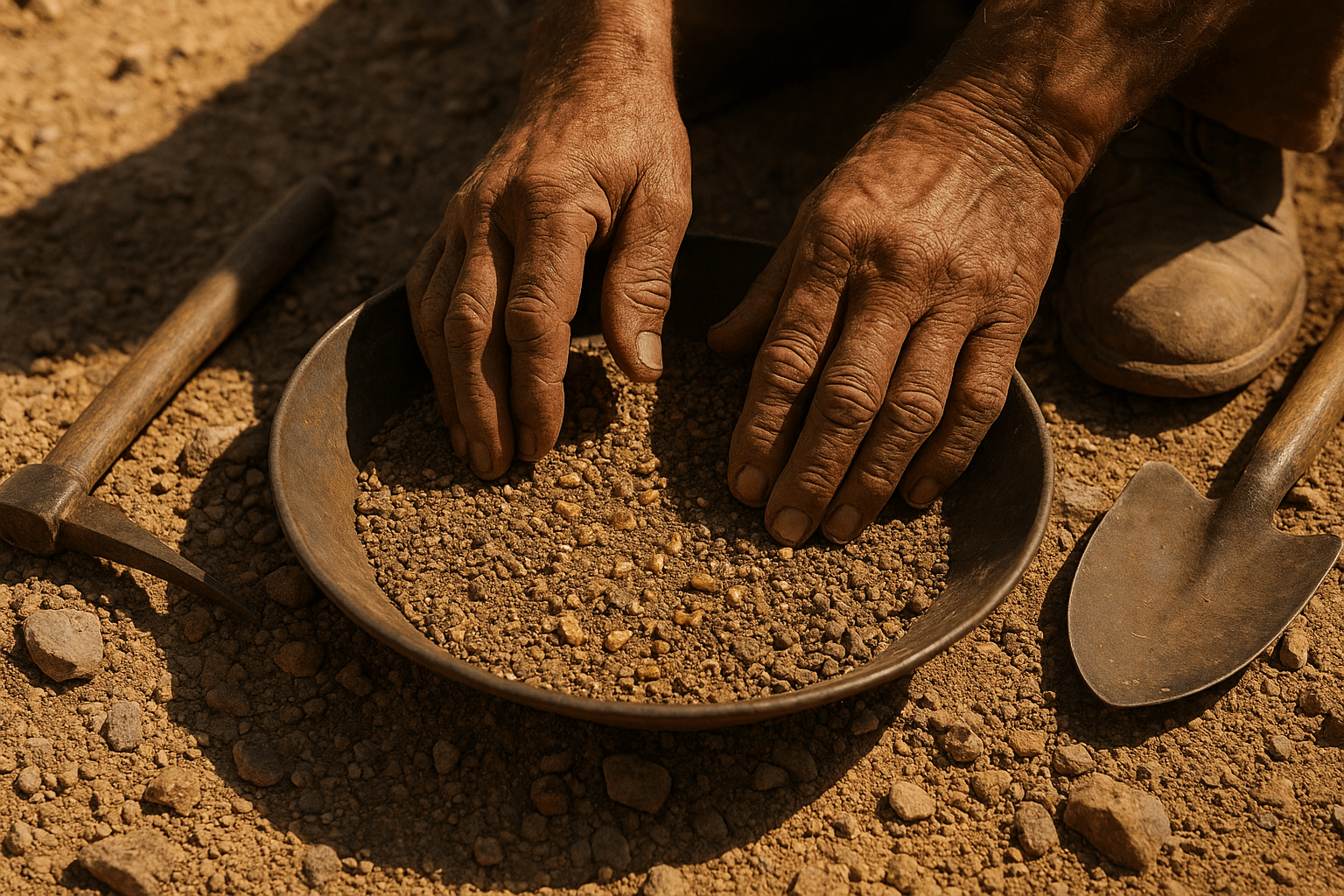
This ground sits near the small community of Congress, in Yavapai County, on land managed today by the Bureau of Land Management. Geographically it’s classic Sonoran desert — scrub brush, exposed granite, long sightlines, and very little natural shade — the kind of terrain that has drawn prospectors to central Arizona since the territory’s earliest mining booms. Rich Hill earned its place in that history in 1863, when placer gold turned up scattered directly in and around the weathered granite of the hillside, in quantities substantial enough that the site became known, in the shorthand of prospectors, as the “Potato Patch” — nuggets described as thick and abundant as potatoes freshly turned from garden soil. That image has stuck for more than a century and a half precisely because it describes something unusual: placer gold that didn’t need to be dug out of buried gravel, sluiced from a streambed, or crushed out of ore-bearing rock, but simply gathered from the surface and the shallow ground beneath it. That kind of near-surface abundance is rare enough that it explains, on its own, why Rich Hill became a benchmark strike rather than a footnote, and why prospectors still bring it up when the conversation turns to legendary Arizona gold ground.
The strike has since been counted among the richest placer gold discoveries in American history, a reputation that has followed Rich Hill through generations of retelling. That reputation isn’t just folklore passed between prospectors — it has continued to be documented by regional and national outlets. HistoryNet’s Wild West magazine profiled Rich Hill’s history in a 2014 feature, and Tucson-based historian William Ascarza has chronicled the site’s mining legacy in his long-running “Mine Tales” column, which has appeared in the Arizona Daily Star and on tucson.com. That kind of sustained journalistic and historical attention is part of what separates Rich Hill from the countless smaller strikes scattered across Arizona’s mining districts. It is a documented piece of the state’s placer gold record, not just a rumor passed down a campfire, and that documentation is exactly what makes it possible to write about the site’s history and legal status with real confidence today.
The Potato Patch Strike of 1863
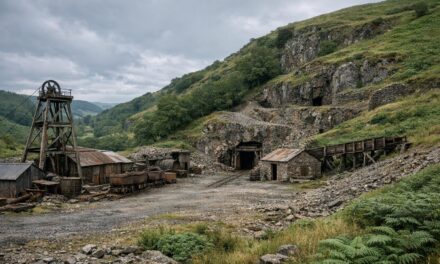
“The gold-bearing ledge atop Rich Hill popped out of the earth with a knife,” expedition leader Captain Pauline Weaver said of the 1863 discovery, in an account preserved in period Prescott newspapers and documented decades later by Prescott Western Heritage Foundation historian Drew Desmond, citing the Weekly Journal-Miner (July 1, 1914) and the Hassayampa Miner (August 18, 1916). Weaver’s own words capture just how easily the “Potato Patch” gave up its gold — nuggets that didn’t need washing out of gravel or crushing out of quartz, just picked loose from the ledge itself, described elsewhere in the same record as “potato-sized.” That abundance produced real, named finds over the decades that followed. The well-known “Tongue Nugget,” recovered near the hill, has become one of the site’s most cited specific recoveries — documented by prospecting bloggers Bill and Linda on their site, mylandmatters.org, alongside their account of hunting the slopes below the Potato Patch near the Lost Dutchman’s Mining Association’s Stanton camp on Antelope Creek. Rich Hill hasn’t stopped producing, either. Prospecting writer Chris Ralph, in an account published in the ICMJ Prospecting and Mining Journal, described attending the annual AZO outing held at the GPAA/LDMA facility in Stanton, at the base of Rich Hill — an event that draws hundreds of attendees, a number of whom found gold right at Rich Hill during the outing itself. The mine shafts and tunnels still scattered across the hillside today — some unmarked, some partially collapsed — date from that original 1863 push all the way through workings as recent as the 1950s. Rich Hill, in other words, wasn’t a strike that boomed once and went quiet. It was worked, on and off, across roughly nine decades of Arizona mining history, and it is still producing gold today for those with legal access to it.
That long working history is also what shapes the site’s legal story today. Under the general federal framework that governs recreational prospecting on Bureau of Land Management and U.S. Forest Service land, casual gold panning and small-scale collecting is typically allowed without special permission — a default built around the idea that dispersed, low-impact recreational use of public land is compatible with other uses. Rich Hill is the exception to that default. Research into the site’s current status — drawing on the same Wild West magazine reporting and William Ascarza’s Mine Tales column — found that the entire Rich Hill area is now covered by active mining claims, posted and actively monitored against mineral trespass. In practical terms, the same nine decades of productive mining that built Rich Hill’s reputation are also what moved the ground, over time, from open public land into claimed and defended territory, watched over by the claim holders who now control it.
Accessing Rich Hill Today
Rich Hill today sits in a legal position worth understanding clearly before anyone plans a visit. The land itself remains BLM-managed, and BLM and Forest Service ground in Arizona generally defaults to open recreational prospecting. That general rule doesn’t apply here. The entire Rich Hill area is blanketed by active mining claims, and claim holders monitor the ground against trespass, so a prospector can’t rely on the general BLM default to justify digging on this particular hillside. Showing up with a pan and expecting to legally work the famous “Potato Patch” ground isn’t realistic. Legal access requires either securing direct permission from a claim holder, or going through a fee-access arrangement. One such option sits nearby: the Lost Dutchman’s Mining Association maintains fee-access property at Stanton, close to Rich Hill, offering a legitimate way to prospect in the same general area under an established club framework, rather than on the claimed Rich Hill ground itself.
Anyone weighing a visit to the area should also take its hazards seriously, whether on claimed ground or fee-access property nearby. This is Sonoran desert scrub country — western diamondback rattlesnakes and scorpions are simply part of the terrain, often seeking shade in exactly the kind of rock crevices and old workings a prospector might want to inspect. Summer heat is extreme with very little natural shade anywhere on the hillside, and the ground itself carries real physical risk from nearly a century of old mine workings, including unmarked or partially hidden shafts and tunnels underfoot that can be easy to miss until it’s too late.
The Legacy of Rich Hill
“Popped out of the earth with a knife” — Captain Pauline Weaver’s words have outlived him by more than a century and a half, and they still describe Rich Hill better than any modern report could. That’s the pull of this hillside for anyone serious about the hobby: it’s one of the rare places where the legend and the paperwork actually agree. The Tongue Nugget came out of this ground. Prospectors at a GPAA/LDMA outing found gold here as recently as Chris Ralph’s own account documents. The “Potato Patch” was never a one-time rush that hardened into folklore — it’s a working strike with a hundred-and-sixty-year paper trail, still producing for those with the right paperwork to dig it. That’s the real irony of Rich Hill: the ground that once gave up gold to a knife blade now requires a permission slip, and the story is only richer for it.
Story Source: tucson.com
Location: Rich Hill, near Congress, Yavapai County, AZ (BLM land)
Site Status: Permission or permit required
Legal Conditions: Tier 1 federal default for Gold Prospecting on BLM/USFS land is generally open recreational collecting (Reported confidence, legal-us-federal-by-category.md). Site-specific research (Reported confidence – HistoryNet/Wild West magazine, 2014, William Ascarza tucson.com Mine Tales column) found the entire Rich Hill area is now covered by active mining claims, posted and monitored against mineral trespass, overriding the general default. Legal access requires permission from a claim holder, or a fee-access option such as the Lost Dutchman’s Mining Association property at nearby Stanton.
Hazards: Wildlife (Western diamondback rattlesnakes, scorpions – Sonoran desert scrub); Mine shaft or collapse hazard (unmarked/hidden shafts and tunnels from 1863-1950s workings); Extreme heat/cold/exposure (Sonoran desert summer heat, minimal shade)
Google Map
Firsthand Accounts
Prospecting writer Chris Ralph described attending the annual AZO (Arizona Outback) outing at Rich Hill in a first-person account published in the ICMJ Prospecting and Mining Journal. Ralph, who flew in from Nevada for two consecutive years, gave lectures on using old mining reports, geologic maps, and aerial photos to locate new nugget patches, while veteran prospector ‘Montana’ Bob Dansie spoke on detecting techniques. Ralph noted the event, held at the GPAA facility in Stanton at the base of Rich Hill, draws hundreds of attendees, and that a number of participants found gold right at Rich Hill during the outing itself. Source: Chris Ralph, published in ICMJ Prospecting and Mining Journal (republished nevada-outback-gems.com).
Prospecting bloggers Bill and Linda documented their own visit to Rich Hill on their personal site, describing hunting the slopes below the Potato Patch near the LDMA’s Stanton camp on Antelope Creek. They noted claim holders are very protective of their ground, with some operations using video surveillance, and pointed out that the well-known ‘Tongue Nugget’ was recovered near the hill. Source: Bill and Linda, mylandmatters.org, personal prospecting account (undated).
In a letter preserved in period Prescott newspapers, expedition leader Captain Pauline Weaver himself described the gold-bearing ledge atop Rich Hill as having “popped out of the earth with a knife.” His account of the 1863 discovery, along with the story of the loose “potato-sized” nuggets found nearby, was documented decades later through Weekly Journal-Miner and Hassayampa Miner newspaper archives. Source: Drew Desmond (Prescott Western Heritage Foundation historian), “Harrison Yarnell and the Mystery of Rich Hill,” PrescottAZHistory, Aug. 23, 2020, citing Weekly Journal-Miner (7/1/1914) and Hassayampa Miner (8/18/1916).